Search This Blog

Showing posts with label Integrity.. Show all posts

Monday, November 05, 2018

States and territories have improved integrity measures, but Commonwealth lags far behind

This article was first published on The Conversation
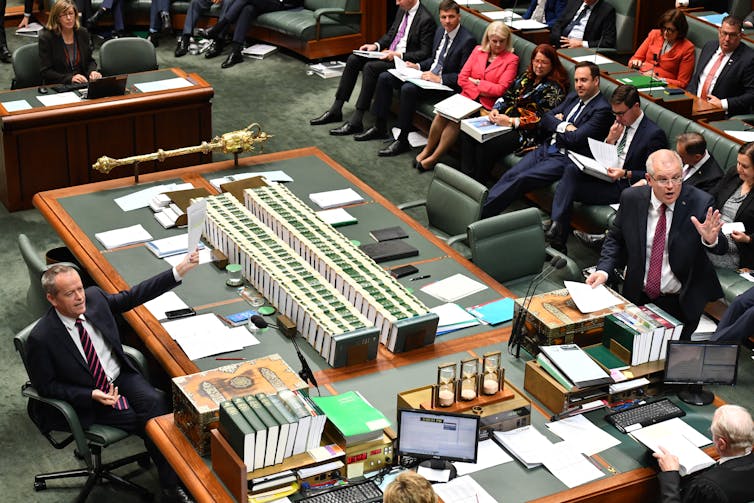


File 20181031 76384 r8f3hd.jpg?ixlib=rb 1.1
Voters want their governments – local, state, and federal – to clean up their act and put integrity reforms high on the agenda. AAP/Mick Tsikas
Danielle Wood, Grattan Institute; Carmela Chivers, Grattan Institute, and Kate Griffiths, Grattan Institute
This week we’re exploring the state of nine different policy areas across Australia’s states, as detailed in Grattan Institute’s State Orange Book 2018. Read the other articles in the series here.

When it comes to cleaning up Australian politics, some states are doing much better than others – and almost all are showing up the Commonwealth government.
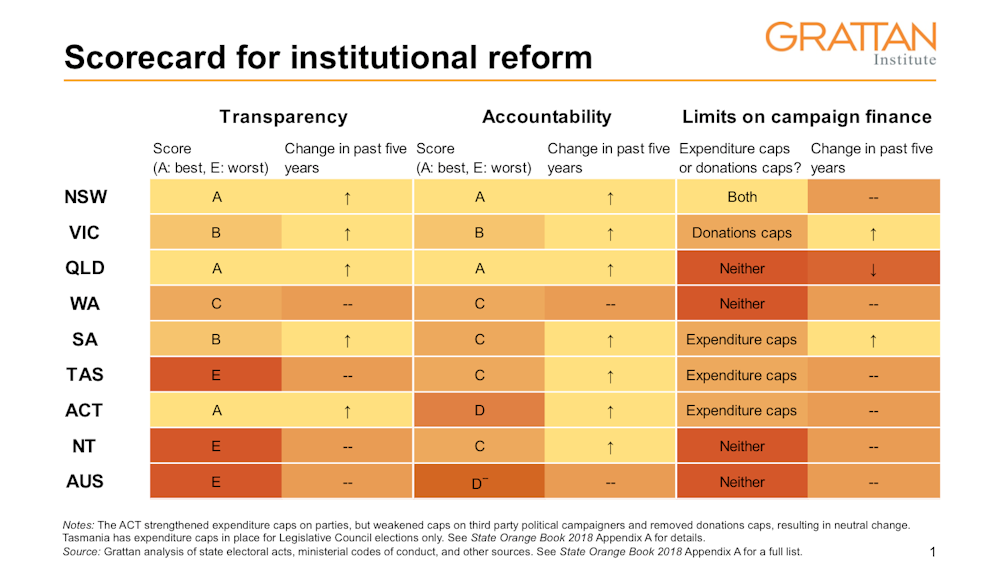
Grattan Institute’s State Orange Book 2018, released this week, compares the states and territories on the strength of their political institutions and checks and balances (among other things). Queensland and NSW received an A grade from Grattan for political transparency and accountability. Both have stronger rules than other states on lobbying and political donations.
Western Australia, once a leader after introducing lobbying reforms in the mid-2000s, is now only middle of the pack. Tasmania and the Northern Territory are the poorest performers – both get an E for transparency of their political dealings. The Commonwealth government sits with them at the back of the pack.


Some states are highly transparent

Some states and territories have made political lobbying much more open to the public gaze. NSW, Queensland and the ACT now publish ministerial diaries, so voters can see who is trying to influence whom, and when. All jurisdictions except the Northern Territory have a lobbyists’ register, and Queensland and South Australia require lobbyists to publish details on which ministers and shadow ministers they meet with.
Most states have also introduced reforms to help voters “follow the money” in politics. NSW, Victoria, Queensland and the ACT require donations of $1,000 or more to be publicly declared. Only Tasmania has the same high threshold as the Commonwealth government ($13,800). Most states and territories require political parties to aggregate small donations from the same donor and declare them once the sum is more than the disclosure threshold. But Tasmania, the Northern Territory and the Commonwealth have left this loophole gaping.

Read more: Influence in Australian politics needs an urgent overhaul – here's how to do it

The disclosure threshold for donations should be no higher than $5,000 in all states and territories, and at the federal level. And donations should be disclosed quickly – preferably within seven days during election campaigns, as now happens in Queensland, South Australia and the ACT, or at least within 21 days, as in NSW and Victoria. Tasmania, and the Commonwealth, still leave us waiting up to 19 months to find out who donated to political parties during elections.

State governments are becoming more accountable

Almost all states have improved their level of accountability to voters in recent years. All states and territories now have a ministerial code of conduct, setting out standards of ethical behaviour, including rules on accepting gifts and hospitality. And all have introduced a similar code for other parliamentarians, or are close to adopting one. The Commonwealth has a code only for ministers.
But enforcement of the codes is typically weak, meaning the codes are more like guidelines than rules. In most states, the premier or the parliament ultimately determine sanctions for misconduct. Enforcement can easily become political.
NSW and Queensland have independent oversight of their codes of conduct. The other states and territories should follow. And there should be meaningful sanctions for misconduct and for breaching disclosure rules – such as large fines or jail time, as applies in NSW.

Read more: Australians think our politicians are corrupt, but where is the evidence?

The states have also made progress in exposing and tackling corruption. All states and the NT now have dedicated anti-corruption or integrity agencies that provide some reassurance to the public that serious issues will be confronted. There is one on the way in the ACT.
Only the Commonwealth lags in this area. It would be naïve to assume that corruption at the federal level is less prevalent or serious than at state level. Establishing an equivalent agency at the federal level should be a priority for the Commonwealth.

All states and the Commonwealth can do better

The appearance, and sometimes reality, of political decisions favouring special interests or politicians’ self-interest has contributed to voter disillusionment and falling trust in government. Voters want their governments – local, state, and federal – to clean up their act and put integrity reforms high on the agenda. Reforming political institutions is both good politics and good policy.
Every state and territory could do better by looking at best practice around the country. States and territories should fill the gaps we have identified in their transparency and accountability frameworks. They should also introduce a cap on political advertising expenditure during election campaigns, to help reduce the power of individual donors and free-up parliamentarians to do their jobs instead of chasing dollars.

Most of all, our laggard Commonwealth government needs to lift its game. Federal ministers should be required to publish their diaries. A list of all lobbyists with security passes to federal Parliament House should be made public and kept up-to-date. Big donations to federal political parties should be disclosed in close to “real time”. And voters should have confidence that misconduct by federal MPs will be independently investigated and punished.
Otherwise, the crisis of trust in Australian politics will only grow.


The Conversation

Danielle Wood, Program Director, Budget Policy and Institutional Reform, Grattan Institute; Carmela Chivers, Associate, Grattan Institute, and Kate Griffiths, Senior Associate, Grattan Institute
This article is republished from The Conversation under a Creative Commons license. Read the original article.

Tuesday, February 16, 2016

What's holding us back from doing something about money, politics and influence?

Important to you?

Join the like-minded as discussion gets underway about public integrity and related topics in the context of development of Australia's Open Government Partnership National Action Plan.

Lots of room for your thoughts, ideas, suggestions and observations. 

Join the Open Government Partnership Network, or tell the Prime Minister's department directly what you think. 

A selection below from media commentary in the last few days prompted by the Stuart Robert scandal - following years of deaf ears to calls for reform.

 Lenore Taylor (Guardian Australia) on Q&A
I think these scandals come and they go, the person resigns if there is enough political pressure but the only thing that will change the system is if we change donation laws and change the relationship between politicians and big money.
Katherine Murphy (Guardian Australia) and Mark Riley (Seven Network) on ABC Insiders (at 37 minutes), in summary:
the conduct of the minister in the Robert case where he seemed to assume he was a tourist while involved in activities to advance the interests of a business friend and political party donor in China, a business in which he held shares, was appalling. It revealed a political culture where people don't know where to draw the line, and pointed up the need for a hard look and a national conversation about corporate interests, money, politicians and power.
Stephen Mayne Crikey: Can Cormann (and Stuart Robert) fix our broken campaign finance system? (Subscription)

Paul Bongiorno in the New Daily
"..the Robert affair points up the shocking inadequacy of Australia’s political donation regime. There is not enough accountability or transparency....Greater donation limitations and transparency are needed urgently to preserve the national interest from greedy vested interests."
Mike Seccombe, The Saturday Paper "Stuart Robert and political donations."
"The evidence of any significant difference between the parties when it comes to ministerial standards is very weak. But there is a difference when it comes to the corrupting influence of political donations, and a very strong correlation between ideology and money. The conservative parties and their big money donors are the major enemies of limits, accountability and transparency...

The conservatives have also pioneered various means of circumventing disclosure, setting up associated entities to collect money, and by moving it between various party divisions to exploit differences in rules between states. That is not to say Labor is squeaky clean, either, but the record clearly shows that when it comes to dubious means of collecting funds, the Coalition tends to be the initiator and Labor the imitator. ....

[as (High Court) Justice Stephen Gageler (in McCloy) noted] that while buying preferential access to government did not necessarily result in corruption, “the line between a payment which increases access to an elected official and a payment which influences the official conduct of an elected official is not always easy to discern”. The implication of his words is obvious: the bigger the donation the bigger the risk of corruption. The elimination of preferential access to government that resulted from the making of political donations was not just “a legitimate legislative objective,” said Gageler. “More than that, the elimination of that form of influence on government is properly characterised as a compelling legislative objective.”

In other words, let’s set limits on donations, so moneyed interests can no longer buy politicians. Because this is not about Stuart Robert; it is about the whole system."
Editorial The Canberra Times "The public service not ministers, remains Australia's corruption risk."
"Ultimately, the Robert affair distracts attention from a deeper failing in government transparency. Federal parliamentarians' financial interests are generally well known; and, as a result, politicians mostly steer clear of obvious conflicts of interest. Yet, in practice, the vast majority of public spending is co-ordinated and approved by senior bureaucrats, not ministers. Unlike politicians, these officials have no need to make any public disclosures of their private interests. Yes, they are required by law to "take reasonable steps to avoid any conflict of interest (real or apparent)" – usually to their direct manager. However, the lack of regular or systematic investigation of these hidden disclosures begs the question: just how many scandals go undetected within the government?
While this secrecy remains, Australians will be unable to be entirely confident that their government – the executive and the bureaucracy – is as squeaky clean as it should be."

Friday, March 13, 2015

The search for supporters of democratic values in NSW election

The St James Ethics Centre and The Sydney Morning Herald have launched the Politicians Pledge campaign to coincide with the New South Wales 2015 State Election.They are encouraging all candidates  to consider taking the pledge – a copy of which is included below and here to download.
"Those contending for election will seek to distinguish themselves from their opponents by focusing on contentious issues of party, ideology and policy. Our aim will be to do what we can to draw community attention to those things held in common that underpin the quality of our democracy."
In the pursuit of power, I will:
  • Act in good conscience;
  • Enable informed decision-making by my fellow citizens;
  • Respect the intrinsic dignity of all;
  • Refrain from exploiting my rivals' private failings for political gain; and
  • Act so as to merit the trust and respect of the community.
In the exercise of power, I will:
  • Give effect to the ideals of democratic government and represent the interests of my electorate as a whole;
  • Abide by the letter and spirit of the Constitution and uphold the rule of law;
  • Advance the public interest before any personal, sectional or partisan interest;
  • Hold myself accountable for conduct for which I am responsible; and
  • Exercise the privileges and discharge the duties of public office with dignity, care and honour.
Like the Fizgerald Principles that received attention in Queensland, they appear remarkably unchallenging.

See the list (and the Moir cartoon) of those who have signed so far- mostly independents, Greens and one Liberal Party candidate.

Hopefully a companion piece soon listing those that refuse?

My local sitting member, and a champion for transparency Alex Greenwich (Sydney) has signed.