Search This Blog

Showing posts with label Accountability.. Show all posts

Thursday, April 09, 2020

Parliament out till August, scrutiny of response to pandemic in the hands of senate committee

At the truncated sitting of the Senate yesterday, the Senate:
debated  in the course of a ministerial statement about the Coronavirus pandemic, whether Parliament would adjourn normal sittings until August, subject to recall by the presiding officers in the event of urgent necessity. And adjourned on that basis; 

approved a motion moved by ALP Senator Katy Gallagher to establish a Senate committee to oversight the Government's response to the COVID-19 pandemic and any related matters, and to report on or before 30 June 2022. The full text is below. An amendment moved by The Greens to establish joint (ie members from both houses) committees to oversight the Pandemic Health Response and the Pandemic Economic Response was opposed by government and ALP senators and failed to pass.

Senator Cormann in his ministerial statement said
"Parliament not sitting for a period does not mean the government is not under scrutiny from the parliament... We will also be supporting the establishment of a dedicated select committee to be chaired by the shadow finance minister, Senator Gallagher, which will be examining and scrutinising the government's response to COVID-19. In fact, our government very much welcomes the establishment of this Senate select committee, which will have as its job to scrutinise and question all of the initiatives and measures taken by our government in responding to the coronavirus crisis.

That committee will be supported from the coalition side by Senator James Paterson, a very experienced committee chair across the broader Prime Minister and Cabinet and Finance portfolios, who will be our nominee for Deputy Chair, and Senator Perin Davey, who will bring an important regional perspective to the work of that committee. All interested senators will be able to participate in that long-term inquiry as they see fit.

It also, of course, remains possible for senators to ask ministers questions on notice, and I know a number of colleagues in this chamber take furious advantage of that opportunity. Furthermore, the parliament may well sit again between now and August, if and as required. The motion the Senate agreed to unanimously when we last met allowed for the President to determine the day and time of the next meeting of the Senate at the request of or with the agreement of the Leader of the Government in the Senate and the Leader of the Opposition in the Senate. That is, in fact, precisely how today's sitting of the Senate came about, and I will be moving a motion to the same effect before the Senate adjourns today. To put it simply: the Senate can sit and will sit to ensure measures are implemented that protect Australians and support the economy, jobs and Australians in need of support, in response to the increasing threat of the COVID-19 coronavirus. But, during this period, we will only sit if that is necessary for us to act consistently, as much as we can, with the public health advice directed by medical experts to all Australians."

Thanks Open Australia for the links.

Monday, November 05, 2018

States and territories have improved integrity measures, but Commonwealth lags far behind

This article was first published on The Conversation


File 20181031 76384 r8f3hd.jpg?ixlib=rb 1.1
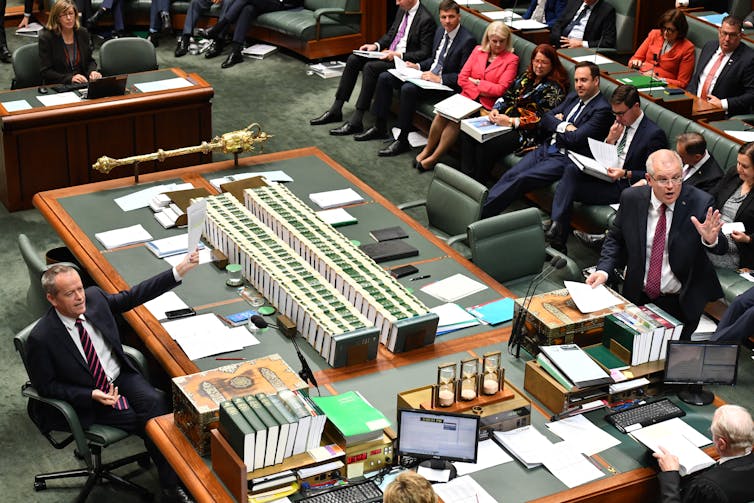
Voters want their governments – local, state, and federal – to clean up their act and put integrity reforms high on the agenda. AAP/Mick Tsikas
Danielle Wood, Grattan Institute; Carmela Chivers, Grattan Institute, and Kate Griffiths, Grattan Institute
This week we’re exploring the state of nine different policy areas across Australia’s states, as detailed in Grattan Institute’s State Orange Book 2018. Read the other articles in the series here.

When it comes to cleaning up Australian politics, some states are doing much better than others – and almost all are showing up the Commonwealth government.
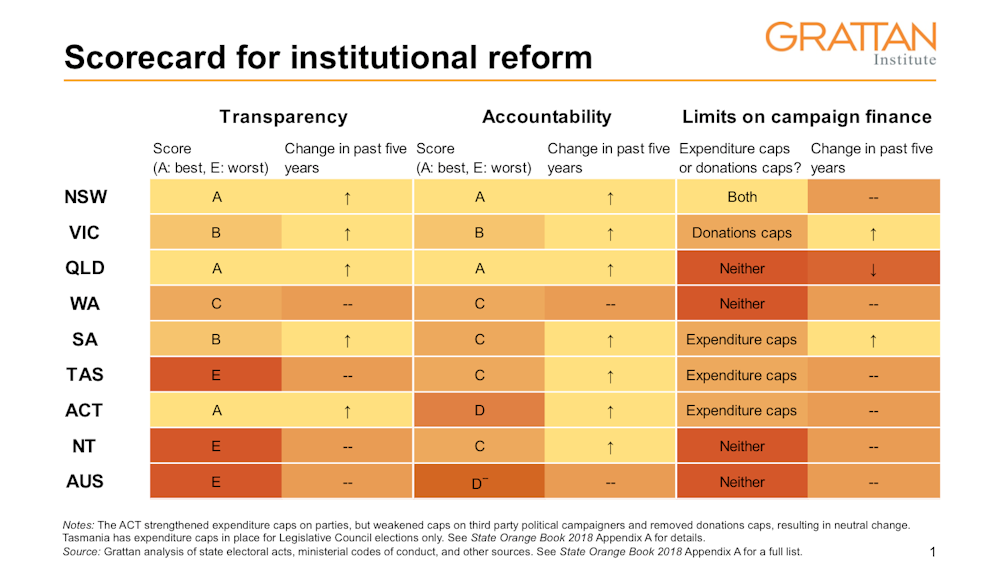
Grattan Institute’s State Orange Book 2018, released this week, compares the states and territories on the strength of their political institutions and checks and balances (among other things). Queensland and NSW received an A grade from Grattan for political transparency and accountability. Both have stronger rules than other states on lobbying and political donations.
Western Australia, once a leader after introducing lobbying reforms in the mid-2000s, is now only middle of the pack. Tasmania and the Northern Territory are the poorest performers – both get an E for transparency of their political dealings. The Commonwealth government sits with them at the back of the pack.


Some states are highly transparent

Some states and territories have made political lobbying much more open to the public gaze. NSW, Queensland and the ACT now publish ministerial diaries, so voters can see who is trying to influence whom, and when. All jurisdictions except the Northern Territory have a lobbyists’ register, and Queensland and South Australia require lobbyists to publish details on which ministers and shadow ministers they meet with.
Most states have also introduced reforms to help voters “follow the money” in politics. NSW, Victoria, Queensland and the ACT require donations of $1,000 or more to be publicly declared. Only Tasmania has the same high threshold as the Commonwealth government ($13,800). Most states and territories require political parties to aggregate small donations from the same donor and declare them once the sum is more than the disclosure threshold. But Tasmania, the Northern Territory and the Commonwealth have left this loophole gaping.

Read more: Influence in Australian politics needs an urgent overhaul – here's how to do it

The disclosure threshold for donations should be no higher than $5,000 in all states and territories, and at the federal level. And donations should be disclosed quickly – preferably within seven days during election campaigns, as now happens in Queensland, South Australia and the ACT, or at least within 21 days, as in NSW and Victoria. Tasmania, and the Commonwealth, still leave us waiting up to 19 months to find out who donated to political parties during elections.

State governments are becoming more accountable

Almost all states have improved their level of accountability to voters in recent years. All states and territories now have a ministerial code of conduct, setting out standards of ethical behaviour, including rules on accepting gifts and hospitality. And all have introduced a similar code for other parliamentarians, or are close to adopting one. The Commonwealth has a code only for ministers.
But enforcement of the codes is typically weak, meaning the codes are more like guidelines than rules. In most states, the premier or the parliament ultimately determine sanctions for misconduct. Enforcement can easily become political.
NSW and Queensland have independent oversight of their codes of conduct. The other states and territories should follow. And there should be meaningful sanctions for misconduct and for breaching disclosure rules – such as large fines or jail time, as applies in NSW.

Read more: Australians think our politicians are corrupt, but where is the evidence?

The states have also made progress in exposing and tackling corruption. All states and the NT now have dedicated anti-corruption or integrity agencies that provide some reassurance to the public that serious issues will be confronted. There is one on the way in the ACT.
Only the Commonwealth lags in this area. It would be naïve to assume that corruption at the federal level is less prevalent or serious than at state level. Establishing an equivalent agency at the federal level should be a priority for the Commonwealth.

All states and the Commonwealth can do better

The appearance, and sometimes reality, of political decisions favouring special interests or politicians’ self-interest has contributed to voter disillusionment and falling trust in government. Voters want their governments – local, state, and federal – to clean up their act and put integrity reforms high on the agenda. Reforming political institutions is both good politics and good policy.
Every state and territory could do better by looking at best practice around the country. States and territories should fill the gaps we have identified in their transparency and accountability frameworks. They should also introduce a cap on political advertising expenditure during election campaigns, to help reduce the power of individual donors and free-up parliamentarians to do their jobs instead of chasing dollars.

Most of all, our laggard Commonwealth government needs to lift its game. Federal ministers should be required to publish their diaries. A list of all lobbyists with security passes to federal Parliament House should be made public and kept up-to-date. Big donations to federal political parties should be disclosed in close to “real time”. And voters should have confidence that misconduct by federal MPs will be independently investigated and punished.
Otherwise, the crisis of trust in Australian politics will only grow.


The Conversation

Danielle Wood, Program Director, Budget Policy and Institutional Reform, Grattan Institute; Carmela Chivers, Associate, Grattan Institute, and Kate Griffiths, Senior Associate, Grattan Institute
This article is republished from The Conversation under a Creative Commons license. Read the original article.

Wednesday, October 21, 2015

Public service chief's FOI 'very pernicious' claim based on false premise.

The responses by Australian Public Service Commissioner John Lloyd to questions in Senate Estimates on Monday suggest Mr Lloyd doesn't know what he is talking about when it comes to information access in the cause of transparency and accountability.

Apparently he didn't know when he described freedom of information earlier in the year as "very pernicious." His comments this week showed he hadn't bothered to find out much since March, or talk to others including ministers about the subject.

The Canberra Times and The Mandarin (registration) report his remarks but neither make the point that Lloyd based his claim on a false premise, and on that basis, ventured an opinion few outside the public service share: that FOI as originally conceived was intended ('particularly') to provide access to information about an individual's dealings with government, and that the law had expanded in the wrong direction since.

FOI law since enacted (after years of public service resistance) is about open, transparent and accountable government. The objects of the act in 1982 and since 2010 are reproduced below.

Reviews, investigations, reports and experience over the years showed that the law and its implementation by ministers and public servants fell a long way short of the promise.Things changed since 1982 across technology, public expectations, and thinking inside and outside government about publication of data and pro-active disclosure of other information.

The 2010 reforms as a result took a few steps in the right direction, but open transparent and accountable government is a long journey, not assisted when public servants (no names no pack-drill) look to thwart the ideals. 

Most who look into the subject, including the last reviewer of the FOI act, Dr Allan Hawke don't give credence to the argument that FOI constrains the public service in providing written frank, professional advice.

The direction on the journey is forward, not back to a past that hasn't existed in any event since 1982.

You have to wonder how comfortable and enthusiastic Lloyd is as leader of the public service in a government led by a prime minister whose stated intention is for government to be more open consultative and participatory. 

Come to think of it, how the Prime Minister feels about it.

Estimates
Lloyd, quizzed (along lines suggested in this post in June) by Senator Rhiannon and Senator Ludwig on Monday about what he meant, said 
"My view is that the FOI laws have extended beyond perhaps what I understood to be the original intention, which was particularly to allow our citizens to have access to information about their affairs that governments were holding. It seems to me that it has come to a stage where people are very reluctant perhaps at times to give advice in writing. I found this throughout my experience in both state and federal governments — both coalition and ALP — over many years. That is often the statement that is made: I would rather not give that in writing. I do not think that was the intention of FOI."
Objects Freedom of Information
As enacted in 1982:
 3. (1) .. to extend as far as possible the right of the Australian community to access to information in the possession of the Government of the Commonwealth by - (a) making available to the public information about the operations of departments and public authorities and, in particular, ensuring that rules and practices affecting members of the public in their dealings with departments and public authorities are readily available to persons affected by those rules and practices; and (b) creating a general right of access to information in documentary form in the possession of Ministers, departments and public authorities, limited only by exceptions and exemptions necessary for the protection of essential public interests and the private and business affairs of persons in respect of whom information is collected and held by departments and public authorities.
As a result of reforms in 2010
 3. (1)  The objects of this Act are to give the Australian community access to information held by the Government of the Commonwealth or the Government of Norfolk Island, by:(a)  requiring agencies to publish the information; and (b)  providing for a right of access to documents.
(2)  The Parliament intends, by these objects, to promote Australia's representative democracy by contributing towards the following:

 (a)  increasing public participation in Government processes, with a view to promoting better-informed decision-making;

 (b)  increasing scrutiny, discussion, comment and review of the Government's activities.

(3)  The Parliament also intends, by these objects, to increase recognition that information held by the Government is to be managed for public purposes, and is a national resource.

(4)  The Parliament also intends that functions and powers given by this Act are to be performed and exercised, as far as possible, to facilitate and promote public access to information, promptly and at the lowest reasonable cost. 

Lloyd on speaking up
Lloyd defended his statement and the right to make it ("I think that, as Public Service Commissioner, I have a responsibility to at times comment on matters which go to the administration and management of the Public Service"; said he hadn't raised it with the minister for public service because responsibility rested with the Attorney General, and he hadn't raised it there either ("They would have been aware of my comment. I did not see the need to actually take it further.") and saw nothing wrong or inappropriate with injecting "a view into the public discussion."

Conclusion
Someone in the Australian Public Service Commission needs to give Mr Lloyd a briefing note before he ventures into public discussion on the topic again. And while he shouldn't need it, a book on how tone at the top influences culture throughout. He has a service wide parish.

A higher authority needs to counter the unfortunate message that FOI has taken a wrong turn and can be labeled very pernicious - extremely "harmful especially in a gradual or subtle way; damaging, detrimental, deleterious."

Extracts from Senate Estimates follow:

Wednesday, March 11, 2015

With two weeks to the NSW election, integrity issues on the fringe, hardly center stage

Integrity issues so far are only on the edge of the NSW election campaign with just two weeks remaining. Maybe Friday night on ABC?

The Liberal and Labor websites are both skinny on policy in any event and 'how we intend to govern' doesn't rate a mention. Neither party has anything to match The Greens policy on Democratic Participation

With politicians low on the trust scale you'd hope how they plan to earn it back would get a full airing.

However to date no mention in the NSW campaign of the Fitzgerald principles that had some impact in Queensland. Hardly a challenge you would think:
1. Govern for the peace, welfare and good government of the State;
2.  Make all decisions and take all actions, including public appointments, in the public interest without regard to personal, party political or other immaterial considerations;
3.  Treat all people equally without permitting any person or corporation special access or influence; and
4.   Promptly and accurately inform the public of its reasons for all significant or potentially controversial decisions and actions.

No mention either of intention to nominate a minister with specific responsibility for integrity and accountability issues in line with newly elected governments in Victoria and Queensland.

The major parties aren't throwing mud from ICAC digs in recent times, presumably because they'll get as good as they give. 

The Greens John Kaye's commentary last July is a little dated but highlights ICAC recommendations from 2010 that both have let go through to the keeper.

Including on Lobbying. The Government introduced welcome reforms in 2014.This was my take on important elements missing.

 Labor in July 2014 said Labor ministers, their staff and departments would no longer be allowed to meet third-party lobbyists, who advocate on behalf of the private sector.  If it was likely to happen that would be a real test of lobbying skills and my guess is they would manage to head it off.

Political donations
NSW already has the most stringest rules in the country and the Schott report released on Christmas eve recommended many improvements in law and practice. Premier Baird has now committed to most recommendations but an editorial in The Sydney Morning Herald points out his failure to fully embrace real-time disclosure of donations to avoid long delays in reporting, and the recommendation for independent oversight of changes to electoral funding limits. Labor's views (last September in the name of current leader Foley's predecessor) were hardly big and bold apart from full public funding, an idea going nowhere. 

The SMH is right:
"If NSW is to have transparent democracy, it needs a world-class electoral funding system."
So too Federal and other state and territory systems that meet that standard.

All round we are a long way short.

Transparency, accountability
Hard to spot any references or commitments so far. The party leaders could be forgiven for not knowing, but seven months ago the Attorney General kicked off a required statutory review of the NSW FOI/RTI equivalent, the Government Information (Public Access) Act. Apart from a call for submissions, silence then and since. The Information Commissioner reports encouraging signs to June last year in the way agencies are implementing the act but "there is still work to be done to promote access to information and achieve the objects of the Act."

While NSW 2009 reforms were steps in the right direction, still plenty of room for improvement in my view. 

One welcome step since July 2014 is the publication of a version of  Ministers' Diaries,
but it hasn't been enacted in legislation.

As to other transparency initiatives?

Digital Age/Open data
Governing in the Digital Age sounds necessary and vital right now rather than a promise for the future. But just an example mind you, nearly every government agency in NSW only accepts snail mail GIPA applications and requires payment by cheque, or wait for it, Money Order.  Then there's "Service NSW.. set up in 2013 by the NSW Government to make it easier for NSW residents and businesses to transact with government." Related example, you can't make a GIPA application for information to any government agency using that facility.

NSW published data sets are said to be 'high value' but whether that's the way those outside government view them is another question; even whether agencies ask those likely to utilise them for accountability or commercial or social reasons. 

Too many data sets published are not in machine readable form, limiting the use of the data. 

The GIPA and Open Data worlds need to be linked not siloed as separate universes. 

Labor seems silent on these issues.

Parliament
Parliamentarians should be lining up to support transparency and accessibility of information in the Interest Register and concerning payment and use of entitlements. Alas.

Other issues such as ethical standards, whistleblowing, and post government employment of ministers are yet to surface either and ICAC supporters and those who support donation reform wait on wisdom from the High Court.

Meanwhile Queensland is acting on some of its integrity commitments as a high priority, so that's a welcome development.

Thursday, March 13, 2014

Transparency, accountability and integrity commitments hard to spot in Tasmanian and SA elections

I haven't dug deep in either state but these issues don't appear to have been anywhere near the forefront in the campaigns leading to the elections this Saturday. 

Maybe it goes without saying like 'truth, justice and Oi, Oi, Oi!'

Glad to hear from you if I've missed something important (and credible).

Tasmania
Tasmanians for Transparency received little encouragement from the major parties in putting forward a 12 point plan (see below) for honest government-see Honest Government not on the election agenda for the Major Parties and Liberals score zero on honest government plan. At least they had a go.

Among the many sprinklings of fairy dust ALP Policy states 
Labor believes in open government and will make every effort to eliminate “commercial-in-confidence” and similar clauses from government contracts and will only retain these where there is a compelling reason to do so. Government contracts will normally be published, where they can be readily scrutinised by the community. 
Perhaps Liberal Party Policy contains something relevant but it doesn't leap out at you. I'll leave The Greens and Palmer United to a deeper digger.

South Australia
Nothing obvious on these issues in the election spread in The Advertiser.

No headline in ALP Policy.

 Liberal Party Policy includes a Justice Action Agenda that contains a commitment to Strengthen the ICAC(pdf) and Strengthen Open Society through Shield Laws (pdf), and at least this mention:
Our commitment to shield laws is part of our Justice Action Agenda to ensure a fair, accountable government and transparent society. Shield laws support the media’s legitimate role in uncovering often difficult evidence and then using that to hold the powerful to account.
In contrast and good for them, transparent and honest government is clearly front and center for The Greens. 

 Palmer has endorsed a team of independents for the upper house.

12 POINT PLAN FOR HONEST GOVERNMENT IN TASMANIA

Thursday, July 11, 2013

TI Corruption Barometer puts spotlight on open, transparent government

The Transparency International Global Corruption Barometer 2013 reports on public perceptions of corruption in 107 countries. 

Results for Australia are based on a survey (prior to March 2013) of 1200 people and includes ratings of institutions as corrupt/extremely corrupt.

Should we be surprised?

Political Parties 58%
Media 58% ( Only four countries gave corruption in the media a high rating-Australia, Egypt, New Zealand and United Kingdom.)
Business 47%
Religious bodies 44% ( But least corrupt in worldwide rankings.) 
Judiciary 36% (Third worldwide)
Parliament/Legislature 36% (Fourth worldwide)
Public officials and civil servants 35% (Fifth worldwide)
Police 33% ( Second worldwide)

We aren't alone on concern about political parties. Globally, "the driving forces of democracy, are perceived to be the most corrupt institutions." 

But Australians put the media and religious bodies way up the list compared to global rankings. And public office holders - judiciary, parliament, public servants and the police - lower down the scale than most others.

However, it's hardly reassuring that more than 1 in 3 rate the parliament and public servants as corrupt.  (NSW developments of course would have clouded the picture.)

And then there's the judiciary!

Five per cent report paying a bribe in the last 12 months.That's remarkable, or I'm showing my innocence or ignorance.

(Correction-5% appears in the published graphic but a reader points out the report doesn’t say that. "On page 10, Australia is listed amongst the countries where ‘<5%’ of respondents reported having paid bribes in the past year.  On page 33, the percentage for Australia is given as 1%.  And that’s in relation to any one of eight services: ‘education system, judiciary, medical and health services, police, registry and permit services, utilities, tax and/or customs, or land services’ (see endnote 11 on page 42)." The reader comments "1% is remarkably high —  but it’s not nearly as bad as 5%." I agree.)
 

In 88 countries the majority of those surveyed consider their government to be ineffective in addressing corruption.

Recommendations in the report won't surprise. They include making integrity and trust the founding principles of public institutions and services with transparency at the top of the list.

(Separately a recent study shows freedom of information laws work to reduce corruption over time, although they are not a quick fix.)

So as we head into pre-election or high election mode, some reflections on recent developments and inaction.

I'm sure these factors don't impact overly on public perceptions. 

But you can only speculate about the influence of a more positive, comprehensive embrace of an openness, transparency, accountability and integrity agenda:
  • The Federal Parliament has just voted to exclude the parliamentary departments from the Freedom of Information Act, and none of the state parliaments other than Tasmania are covered by state FOI law.
  • Dr Hawke's report on review of the Freedom of Information Act is yet to appear in public, and may or may not suggest changes that could see Australian FOI law move up from the current ranking of 48 of 93 countries surveyed. 
  • Despite undertakings by former Prime Minister Gillard in 2010, we don't have a Parliamentary Integrity Commissioner. Legislation proposed by The Greens Adam Bandt. in May 2012 to create  the National Office of Integrity Commissioner, comprising three elements—the National Integrity Commission, the existing Australian Commission for Law Enforcement Integrity (ACLEI) and a new Office of the Independent Parliamentary Advisor - got nowhere.
  • Similarly a Code of Conduct for Federal parliamentarians. Opposition backbencher Steven Ciobo told Parliament these sort of feel good things are a waste of time:
"The reason that there is still behaviour that people frown upon is that, fundamentally, it comes down to individual choice. Simply adding one more document to a pile of documents and simply having one additional public servant called an integrity commissioner is not going to change a thing. Anyone who believes that it will is delusional. It has not changed things in other jurisdictions. It is not as if in the United Kingdom or in the state of Queensland, where these types of vehicles exist, there is this great love of the parliament or towards parliamentarians. No. The same problems exist in those jurisdictions. This is nothing more than a feel-good exercise that will deliver no net tangible benefit whatsoever."
  • Political donation and lobbying laws are weak and reform efforts in recent years amounted to nothing.
  • Silence on the Australian Law Reform Commission recommendation five years ago that the exemption for political parties from the Privacy Act should be removed. ("In the interests of promoting public confidence in the political process, those who exercise or seek power in government should adhere to the principles and practices that are required of the wider community..")
Yes, yes i know good whistleblower protection legislation did pass in the dying days of the last parliamentary sitting after Attorney General Dreyfus rescued the bill from years in the too hard bin. Addendum: but as a reader points out, the major parties opposed changes to the legislation that would provide protection for public officials who report wrongdoing by, you guessed it, politicians.

Bearing all this in mind, we wait to hear what the Government or the Attorney General's Department has to say about a National Action Plan, required by our membership of the Open Government Partnership, with transparency and accountability the touchstone to improving the way our democracy operates.