Search This Blog

Sunday, May 31, 2020

High Court ruling on 'Palace letters' case paves way to learn more about The Dismissal - and our Constitution


National Archives of Australia

Anne Twomey, University of Sydney
 

The High Court has ruled that Sir John Kerr’s correspondence with the queen comprises “Commonwealth records”. This means access to them is now in Australian hands and can no longer be vetoed by the private secretary to the queen.
This correspondence, which includes Kerr’s briefings to the queen on the political crisis prior to the dismissal of the Whitlam government on November 11 1975, and his explanation to her afterwards of why he exercised this power, have so far been kept from public view.

Read more: Explainer: what is the 'palace letters' case and what will the High Court consider?

The High Court’s decision opens the possibility that we will finally see the last pieces of factual evidence about The Dismissal – revealing the concerns and reasoning of the governor-general, as events occurred, without the gloss of hindsight.
It could even allow this festering wound in our political history to be healed, once all the information has been revealed. But it depends now on what the National Archives does next.

How were these letters treated until now?

Until now, the National Archives has claimed all correspondence it holds between governors-general and the queen, even when written in their official capacities, is “personal” and not a “Commonwealth record”.

This means there was no legal obligation on the National Archives to provide public access to these letters. Instead, the National Archives had stated it could only release these documents in accordance with the conditions placed on them by the person who lodged them with the National Archives.
But it let those conditions be changed on the instructions of the queen in 1991 so that her private secretary and the secretary of the governor-general held a veto over the release of any such correspondence.

Read more: Australian politics explainer: Gough Whitlam's dismissal as prime minister


Professor Jenny Hocking. AAP/James Ross

In the case brought by academic Jenny Hocking against the National Archives, the High Court held by a majority of six to one that the letters between Sir John Kerr and the queen were created, received and held as institutional documents by the “official establishment of the Governor-General” before being transferred to the National Archives by the official secretary to the governor-general in his official capacity. This level of official control over them was enough to make them “Commonwealth records”, even if the governor-general still held ownership rights over them (which the majority said it did not need to decide).

In their joint judgment, Chief Justice Kiefel and Justices Bell, Gageler and Keane said they could not see how the correspondence could be described, however “loosely”, as “private or personal records of the Governor-General”.

They said it could not be supposed that Kerr could have taken the correspondence from the governor-general’s official establishment and destroyed or sold it.

Justice Gordon thought even if Kerr did have property rights in the original documents, he gave up any claim to them when they were deposited with the National Archives. Justice Edelman agreed the correspondence between the governor-general and the queen was “created or received officially and kept institutionally”.

Only Justice Nettle concluded these letters were personal communications between Kerr and the Queen, and were not Commonwealth records.

Does this mean we get to see the letters now?

The court did not order that the letters be publicly released. Instead, it ordered the director-general of the National Archives reconsider Jenny Hocking’s request for access to the correspondence held by the archives, treating them as Commonwealth records.

Section 31 of the Archives Act 1983 requires the National Archives to give public access to any Commonwealth record that it holds that is within the open access period and is not an “exempt record”.

The correspondence between Kerr and the queen has been in the “open access period” since 2006/2007. The only question that remains is whether the director-general will now claim that the correspondence is comprised of “exempt records”.

Section 33 of the Act lists a number of exemptions. These include documents that could reasonably be expected to cause damage to international relations, or where disclosure of matters in the record would constitute a breach of confidence.

The damage that might be caused by the release of documents necessarily diminishes over time. So even if these exemptions are claimed, consideration would have to be given to whether they remain applicable, given the age of the documents.

The director-general of the National Archives responded to the High Court’s decision by stating the “National Archives is a pro-disclosure organisation” that operates on the basis of making records publicly available “unless there is a specific and compelling need to withhold it”.
It will be interesting to see what “compelling” needs it might identify.

Are there any wider implications of the decision?

The High Court’s decision will also affect the release of correspondence by other governors-general. The release of Lord Casey’s correspondence with the Queen was recently blocked by Buckingham Palace, which stated it would refuse access to any correspondence with the queen until at least five years after her death, and then only if the private secretary to the new monarch agrees. That veto has now been destroyed by the High Court.

So not only is Kerr’s correspondence with the queen liable to be opened, but also the correspondence by all other governors-general with the queen, when it is in the “open access period” and subject to any exemption.

That may mean we get a better idea of how the roles of the governor-general and the queen operate under our Constitution, which would be a good thing.The Conversation


Anne Twomey, Professor of Constitutional Law, University of Sydney
This article is republished from The Conversation under a Creative Commons license. Read the original article.

Saturday, May 30, 2020

New look federalism: National Federation Reform Council, National Cabinet.

From the Prime Minister's Statement yesterday

National Cabinet

National Cabinet has agreed to the formation of the National Federation Reform Council and the cessation of the COAG model.

National Cabinet has worked effectively to respond to COVID-19. The new National Federation Reform Council agreed to by Premiers, Chief Ministers and the Prime Minister, will change the way the Commonwealth and states and territories effectively and productively work together to address new areas of reform.

The National Cabinet will be driven by an initial single agenda - to create jobs. A job making agenda.
By any measure, National Cabinet has proven to be a much more effective body for taking decisions in the national interest than the COAG structure.

At the centre of the National Federation Reform Council will be National Cabinet.
National Cabinet will continue to meet regularly and will be briefed directly by experts such as the Australian Health Protection Principal Committee.

Initial reform areas will be agreed by National Cabinet.

During the COVID-19 period, National Cabinet will continue to meet every two weeks. In the future, these meetings will take place once a month.

The Council on Federal Financial Relations (CFFR), which is essentially a meeting of all Treasurers, will report to National Cabinet. CFFR will take responsibility for all funding agreements including National Partnership Agreements.

Important taskforces will continue in areas that are critical to our National Agenda. The taskforce on women’s safety and domestic violence will continue their critical work, as will the Indigenous affairs taskforce with a particular focus on Closing the Gap.

Once a year, National Cabinet, CFFR and the Australian Local Government Association will meet in person as the National Federation Reform Council with a focus on priority national federation issues such as Closing the Gap and Women’s Safety.

This new model will streamline processes and avoid endless meetings that do not result in action. This is a congestion busting process that will get things done with a single focus on creating jobs.
This is an exciting new agenda for our federation and is about rebuilding confidence to get Australians back into work.

Further details of the National Federation Reform Council and consolidation and reset of the Ministerial Forums and Ministerial Regulatory Councils will be reviewed by National Cabinet.

Thursday, May 28, 2020

Transparency during the crisis, business as usual?

The full extent of how the COVID 19 crisis is impacting on transparency and accountability at the federal or state level is unknowable to us outsiders-maybe information commissioners could have a look and tell us, warts and all ? But what you can glean from the public record suggests the longstanding attachment, in Canberra certainly, to secrecy, confidentiality and guarding the barricades against the inquisitive and interested is hard to shake.
Particularly when you try to get close to the cabinet door.

The Senate- No date-Executive Privilege?

The  ongoing hearings of the COVID 19 Senate select committee has seen parliamentarians dig deep with some warranted success given Parliament's role and responsibility to oversight executive government, and the response to the pandemic.

However those appearing before or providing information to the committee are sticking to the usual ground rule that if information asked for or sought gives rise to something close to a plausible reason to keep the shades drawn, go for it.


When Senator Katy Gallagher Chair of the committee on 13 May asked officers from the Department of Prime Minister "the date on which Professor Murphy (Chief Medical Officer) first briefed the Cabinet about COVID-19?" the question was taken on notice.On the same day PMC came back with the Answer (No 30)
"Revealing information about when the Chief Medical Officer, Professor Brendan Murphy, first briefed the Cabinet on the coronavirus pandemic would or could reasonably be expected to disclose the deliberations of the Cabinet. 
It is a longstanding practice not to disclose information about the operation and business of the Cabinet and its committees, including when a matter went to the Cabinet, who attended, and what form of submission was provided, as to do so could potentially reveal the deliberations of the Cabinet, which are confidential. 
The deliberations of the Cabinet and its committees should be conducted in confidence so that the freedom of those deliberations can be preserved. It is not in the public interest to disclose information about the Cabinet’s deliberations as it may impact on the Government’s ability to receive confidential information and make appropriate decisions impacting on the Australian community. 
This approach has been used consistently for several years and is consistent with the approach taken by previous Secretaries."
(All the date would reveal was that the cabinet met that day and heard words from Professor Murphy's lips. It wouldn't reveal what he said, what discussion if any ensued and who said what, what if any decisions were taken, but that a deliberation had taken place.

Head things off at the pass


Something similar occurred at a hearing on 26 May when Senator Gallagher asked Professor Murphy:
"I presume you've been briefing the National Security Committee of cabinet on those improvements in the modelling of the health data over the last eight weeks.

Prof. Murphy : The national cabinet has been briefed on those and the National Security Committee less so. At the national cabinet, the premiers and the Prime Minister generally get an update on the modelling at every meeting.

CHAIR: What about the federal cabinet?

A simple Yes, maybe even a No might have done it but Acting Secretary of the Department of Health (seconded from her job as Deputy Secretary of Department of Prime Minister and Cabinet was up to the mark:
 

Ms Edwards : Of course, Professor Murphy is not really at liberty to discuss what advice he's given to cabinet.

Leading to:

CHAIR: I'm talking about the modelling and whether or not that's been provided. I'm not asking what the modelling is and what it's saying and what might not have been released. I am asking whether the Chief Medical Officer has provided modelling to the NSC.
.....

Ms Edwards : Very comprehensive advice is provided to government at all stages through the ordinary processes, including the confidential cabinet processes.

CHAIR: But you won't confirm whether the modelling has been provided to the cabinet?

Ms Edwards : In accordance with the standard practice, we don't provide detail of what advice has been provided to cabinet in confidence.

CHAIR: No, the committee hasn't accepted that, and we have repeatedly made it known to witnesses that if you are going to deny an answer to questions then you must indicate whether you are going to seek public interest immunity. You need to explain the public harm that comes from letting us know whether the cabinet has received modelling information as the health curve has been flattened. That is the question. If you think that's a harm to public interest then refer it to your minister and go through that process, Ms Edwards. I would think it's a fairly straightforward question for this committee to ask.

Ms Edwards : We'll refer to the minister whether he wants to claim public interest immunity in relation to what's been provided to cabinet.

CHAIR: About whether they're doing their job properly.
....

CHAIR: My question is whether the NSC of the federal cabinet have been briefed on the modelling as the curve has flattened. That is my question. If you're unable to answer that simple question today and it needs to be referred to your minister, please indicate if that's the case.

Ms Edwards : That's what we'll have to do.

CHAIR: Right. It really makes the scrutiny role of this committee an absolute joke. ....

Give a little-pass the parcel 

Questions about briefs and modeling were also asked of Treasury Secretary Dr Steven Kennedy.  As the Sydney Morning Herald reported in April Treasury released parts of this ministerial brief dated 30 January on economic impacts-before the full scale of the damage to the economy was realised. 
It has published and updates the Government Economic Response
The Senate committee asked for more. Dr Kennedy in a letter of 19 May provided a copy of another January ministerial brief providing background on the SARS epidemic of 2003 and commentary about its current relevance, and referred to some publicly available documents, but said other documents requested were prepared for cabinet deliberations and were a matter for Department of Prime Minister and Cabinet. 

The National Cabinet

Brewing away in the background here is the significance in terms of transparency of the claim put out there most notably by PMC Secretary Phillip Gaetjens at that hearing on 13 May that the National Cabinet is part of the Federal government governance structure, indeed part of the federal cabinet. Suffice here to say Mr Gaetjens was clear and definite in his evidence:
Senator PATRICK: In relation to the national cabinet, I heard you saying at the start—and I apologise; I came in late—that, in effect, it is part of the federal cabinet?
Mr Gaetjens : Yes.
It's very doubtful in my opinion.

More on that in the next post.

FOI- we're hard pushed

On the Freedom of Information front, delays and requests for extra time are the order of the day and many/most are understandable. However from what's visible through FOI applications using the Right to Know platform "complex or voluminous" is getting quite a workover.

Just hard
On access to documents not a lot in the public domain at present.
PMC dealt with a Freedom of Information request from Senator Rex Patrick for the early briefings provided to Prime Minister Morrison on the beginning of the coronavirus outbreak by giving nothing away.

As Senator Patrick recounts:

"I was hopeful that the Department would release some useful information that would shed light on the Government’s early assessments and responses in January. A high level of transparency is essential if we are to learn all the lessons we can from the experience of this terrible pandemic."
However the Department of Prime Minister & Cabinet has refused access to all of the requested briefings given to the Prime Minister at the beginning of the crisis.
"The Government has piled on every exemption category it can think of – international relations, national security, internal government deliberations and Cabinet business – to withhold every word of five briefings provided to the Prime Minister between the first and thirty first of January. This was the critical time in which the Government first received reports of the coronavirus outbreak, and first learned of human-to human transmission, but decided to only screen flights from Wuhan and hand leaflets to passengers arriving from China."
"The Department of the Prime Minister and Cabinet’s blanket refusal to release early briefings to the Prime Minister at the beginning of the COVID-19 crisis is deeply disappointing and quite at odds with the Government’s claimed commitment to transparency," said Senator Patrick.

Ariel Bogle online technology reporter at the ABC also struck out, giving this cryptic account on Twitter 


"I've been refused FOI access to the government's privacy impact assessments for the coronavirus WhatsApp channel & info app. Seems odd given the one for COVIDSafe was released for public confidence. (They say it would inhibit frank advice from legal advisers, among other things)"

Senator Patrick is out there again at the moment this time flagging 'cabinet in confidence' may stand between the public right to know and Treasury modeling that led to the $60 billion Job Keeper bungle, calling  

" ..on Treasurer Josh Frydenberg to immediately release Treasury JobKeeper modelling after the Government committed the biggest accounting error in Australia’s public administration history."Treasury modelling may well have caused Government to suffer from a bad case of confirmation bias," said Senator Patrick.Senator Patrick pressed Treasury Secretary Dr Kennedy last Thursday for the modelling to be released to the Senate’s COVID-19 oversight committee. "I put to you that all the modelling your department does is done on the public coin and for public purpose, and the public has a right to see what it is that your department has done. I think it is disrespectful for the Treasury to withhold that information from the public.""If there wasn’t enough reason last Thursday, there’s 60 billion more reasons now."Dr Kennedy hinted a cabinet-in-confidence claim would be used. "I think most Australians are getting sick and tired of the Government sprinkling ‘Cabinet fairy dust’ on just about anything that might prove embarrassing to Government," said Senator Patrick.

Sure to be plenty more of this in the pipeline.

Thursday, May 14, 2020

Privacy Commissioner and OAIC expected to do more on the smell of the same oily rag?

The Office of Australian Information Commissioner was asked again to do more with no additional resources, something it should be used to by now after six years of practice. That's since since the Abbott government had an unsuccessful crack at abolishing the Commission and successive governments in the years since kept the lid closed or just slightly ajar (with some additional privacy resources in last year's budget to go with earlier expansions of its role) on the moneybox. 
But wait-despite no one on the government side deviating from the script during debate the Attorney General told Shadow Attorney General Dreyfus separately his department is checking with the OAIC to ensure they have adequate resources.
(Perhaps too much to hope that the check might also dig into the issue of stretched OAIC Freedom of Information resources that include one commissioner instead of three as legislated, and to deal with something like a 90% increase in FOI review applications over the last four years that now form a long,long queue, and non existent resources for Information Policy functions.)
The OAIC issue arose as the Privacy Amendment (Public Health Contact Information) Bill 2020 sailed through both houses when Parliament sat this week.
The bill, as passed by the House of Representatives on Wednesday, passed the Senate this morning without amendment. 
Labor in the Senate did not support amendments put by the Greens and Centre Alliance citing the urgency of getting the legislation in place as quickly as possible.

Speakers in both houses drew attention to the extra responsibilities the bill places on the Privacy Commissioner and her office the OAIC, particularly this exchange in a committee hearing last week 
Senator Keneally: in light of the new and important oversight responsibilities that the draft bill would confer on the Privacy Commissioner, will the government be providing the Privacy Commissioner with any additional resources?
Ms Chidgey (Attorney General’s Department): There's no intention to provide additional resources. The Privacy Commissioner is able to undertake this work within their existing resources.
Shadow Attorney General Mark Dreyfus unsuccessfully moved a motion in the House that included a call call on the government to "provide additional funding to the (OAIC) and appoint a standalone privacy commissioner “to ensure that the commissioner is able to properly perform the important oversight functions provided for in this bill.” 

He spoke to this part of the motion thus:
"Another issue that I raised with the Attorney-General during discussion about this bill relates to the funding of the Office of the Australian Information Commissioner. In short, I do not think that the evidence of the Attorney-General's Department at last Wednesday's COVID-19 Senate select committee hearing that the commissioner requires no additional resources to fulfil her new oversight responsibilities is credible.In fact, it is incredible. You do not have to take my word for it. Just last October, the Information Commissioner told Senate estimates that her office is already underresourced.The Attorney-General has advised me that his department is engaging with the commissioner to ensure that she has the necessary resources to perform the important oversight functions provided for in this bill, the Privacy Amendment (Public Health Contact Information) Bill 2020. While I welcome that engagement and look forward to receiving an update over coming days or weeks, there is no question in my mind that additional funding is urgently required. The only question is how much.
It is also important to remember that for years the government has refused to appoint a standalone information commissioner, a standalone freedom of information commissioner or a standalone privacy commissioner. Instead, one person currently occupies all three of these important and demanding roles. As I've said repeatedly, this is unacceptable. In light of the new responsibilities that this bill would confer on the Office of the Australian Information Commissioner, now more than ever the government needs to appoint a standalone, dedicated privacy commissioner. The appointment of a full-time and properly resourced privacy commissioner rather than a commissioner forced to split her time between three different and demanding roles would make a further valuable contribution to building public confidence in the COVIDSafe app. It should not take a public health crisis for the government to show that it takes seriously the privacy of Australians.
Additional responsibilities for the Privacy Commissioner arise because as explained in the second reading speech:
  • The bill ensures COVIDSafe app data must  be treated as 'personal information' under the Privacy Act, by virtue of section 94Q. This automatically applies a range of existing Privacy Act protections to COVIDSafe app data, including privacy policy, notification, and security obligations. 
  • The commissioner will be able to undertake a formal assessment of whether an entity subject to the Privacy Act, or a state or territory health authority handling COVIDSafe app data, is complying with the requirements in this bill. And to deal with complaints.
  • The commissioner will also have discretion to refer matters that may constitute a breach of a state or territory privacy law to the responsible state or territory privacy regulator. 
  •  The commissioner will provide regular public reports on the performance and exercise of her new powers and functions under part VIIIA.
  • The bill applies the existing Notifiable Data Breaches Scheme for which the commissioner is responsible to COVIDSafe app data under section 94S. The bill requires the administrator of the National COVIDSafe Data Store, or a state or territory health authority handling COVIDSafe app data, to notify the commissioner of any data breach involving COVIDSafe app data. The commissioner will then have the power to require the breach to be notified to affected individuals.The notification requirement would be automatic in the event of a data breach, which is much stronger than the protection in the Privacy Act's existing data breach notification requirements. 
Somewhere in there in there is also a COVIDSafe Privacy Advisory Committee, including the various Privacy Commissioners, to provide collective advice to the National Cabinet and the public regarding the operation of COVIDSafe.
The Commissioner welcomed changes to the act-no mention of the resources issue
Should be a snack really.


Tuesday, April 21, 2020

"National Cabinet" not Cabinet as we have known it


Explainer: what is the national cabinet and is it democratic?


AAP/Mike Bowers
Jennifer Menzies, Griffith University
Crises pose particular challenges for democratic leaders. They are expected to make critical decisions in times of uncertainty and rapidly develop effective plans to lead us out of the crisis. Normally, we are more interested in constraining our leaders through the checks and balances of accountability. But in times of crisis, we look to our leaders to lead. Finding the right balance between accountability and rapid decision-making remains a challenge during an era of reduced trust in political leaders.
In Australia, the establishment of the national cabinet has undertaken this crisis leadership role.
The national cabinet comprises the prime minister and all state and territory premiers and chief ministers. Basically, it is COAG by another name.

Read more: 'Where no counsel is, the people fall': why parliaments should keep functioning during the coronavirus crisis

Though called a cabinet, the national cabinet is technically an intergovernmental forum. The conventions and rules of cabinet, such as cabinet solidarity and the secrecy provisions, do not apply to the national cabinet.
Its power is that which the leaders of all Australian jurisdictions bring to negotiate on behalf of their people, and to implement the decisions reached. This model is called executive federalism.

Advantages of executive federalism in a time of crisis

In a crisis, decision-making automatically shifts upwards with the expectation that leaders will work together to find a way through the crisis. The National Cabinet meets these expectations in several ways.

Timeliness and risk
Response time is critical, and with the national cabinet meeting multiple times a week, issues can be addressed as they emerge. Risk is reduced by bringing together technical and political experts.
The national cabinet is supported by the chief medical officers, who meet as the Australian Health Protection and Principles Committee (AHPPC). They pull together the modelling, research and data that form the basis of decisions made by the national cabinet.

Read more: View from The Hill: A contest of credible views should be seen as useful in a national crisis

The national cabinet is the mechanism to bring together information and intelligence sharing, and the capacity to pool and test ideas before locking in coordination and jurisdictional capacity.
Because of the frequency of meetings, decisions are expected and made. The consideration of different jurisdictional viewpoints and expertise puts rigour and contestability into the decision-making and strengthens the outcome.

Clarity and coherence
In a time of national crisis, agreement on a plan of action and then rapid and effective implementation is crucial. The national cabinet brings that focus. By putting aside their “politics as usual” squabbles the leaders demonstrate their desire for agreement and unity and communicate that firmness of purpose to the community at large.

Though the search for unity can be overborne by local circumstances. Some states moved earlier to introduce restrictions and shutdowns outside of the national cabinet. Though criticised for breaking ranks, the premiers were reacting to the different circumstances and anxiety within their jurisdiction. They decided to trade off the perception of a loss of unity against the need to create local responses for local circumstances.

Dual democracy
The national cabinet helps reconcile the dual allegiances citizens have to the national government and their state or territory government. People are looking for a coherent national approach through the crisis, but they do not want to see their individual jurisdiction to be disadvantaged compared to the rest of the country. At the national cabinet, the smaller states have equal representation, whereas in parliament their representation is proportionate to their population size.

Is it anti-democratic?
Executive federalism forums such as the national cabinet can be criticised for being undemocratic and unaccountable, with the role of the parliament marginalised. However, these forums are undertaking different roles. The national cabinet deals with negotiation and compromise between states, which recognise difference and diversity. The parliament is about majority will.
The connection has not been lost with parliament, which is suspended not pro-rogued, and will be brought back to pass legislation from decisions made by the national cabinet.

Once the COVID-19 crisis has passed, the full democratic accountability processes can scrutinise the decisions taken. This includes parliamentary committee investigations and royal commissions. The checks and balances of the democratic constraints on our leaders will reassert themselves.The Conversation


Jennifer Menzies, Principal Research Fellow, Policy Innovation Hub, Griffith University
This article is republished from The Conversation under a Creative Commons license. Read the original article.
Thursday, April 09, 2020

Parliament out till August, scrutiny of response to pandemic in the hands of senate committee

At the truncated sitting of the Senate yesterday, the Senate:
debated  in the course of a ministerial statement about the Coronavirus pandemic, whether Parliament would adjourn normal sittings until August, subject to recall by the presiding officers in the event of urgent necessity. And adjourned on that basis; 

approved a motion moved by ALP Senator Katy Gallagher to establish a Senate committee to oversight the Government's response to the COVID-19 pandemic and any related matters, and to report on or before 30 June 2022. The full text is below. An amendment moved by The Greens to establish joint (ie members from both houses) committees to oversight the Pandemic Health Response and the Pandemic Economic Response was opposed by government and ALP senators and failed to pass.

Senator Cormann in his ministerial statement said
"Parliament not sitting for a period does not mean the government is not under scrutiny from the parliament... We will also be supporting the establishment of a dedicated select committee to be chaired by the shadow finance minister, Senator Gallagher, which will be examining and scrutinising the government's response to COVID-19. In fact, our government very much welcomes the establishment of this Senate select committee, which will have as its job to scrutinise and question all of the initiatives and measures taken by our government in responding to the coronavirus crisis.

That committee will be supported from the coalition side by Senator James Paterson, a very experienced committee chair across the broader Prime Minister and Cabinet and Finance portfolios, who will be our nominee for Deputy Chair, and Senator Perin Davey, who will bring an important regional perspective to the work of that committee. All interested senators will be able to participate in that long-term inquiry as they see fit.

It also, of course, remains possible for senators to ask ministers questions on notice, and I know a number of colleagues in this chamber take furious advantage of that opportunity. Furthermore, the parliament may well sit again between now and August, if and as required. The motion the Senate agreed to unanimously when we last met allowed for the President to determine the day and time of the next meeting of the Senate at the request of or with the agreement of the Leader of the Government in the Senate and the Leader of the Opposition in the Senate. That is, in fact, precisely how today's sitting of the Senate came about, and I will be moving a motion to the same effect before the Senate adjourns today. To put it simply: the Senate can sit and will sit to ensure measures are implemented that protect Australians and support the economy, jobs and Australians in need of support, in response to the increasing threat of the COVID-19 coronavirus. But, during this period, we will only sit if that is necessary for us to act consistently, as much as we can, with the public health advice directed by medical experts to all Australians."

Thanks Open Australia for the links.

Monday, March 09, 2020

Pass the hot parcel when questions are raised about 40 years of records in the bin

The testimony in a senate committee hearing on the Sports Rorts affair that retiring Secretary of the Department of Health Glenys Beauchamp had destroyed all of the notes and notebooks from her public service career at the end of January led to further inquiry in Senate estimates last week. The hot potato of course was the notes if any that had been kept then destroyed about meetings concerning the tortuous decision making on community sports grants.

Senate Estimates on this bore passing resemblance to pass the parcel but there was no prize for anyone when the music stopped-for the moment at least.

In short:

Australian Public Service Commissioner Peter Woolcott said he hadn't carried out an investigation into the matter as requested by Senator Gallagher because he didn't have authority and the Attorney General's Department not the Commission was the agency responsible for the Archives Act. Senator Gallagher noted the APSC website had a lot of information about record keeping. Woolcott said this was all to do with the broader issue of integrity and the APS Code of Conduct but "I have no room to investigate Ms Beauchamp at this point." 

The Attorney General's Department couldn't say one way or the other whether destruction of the notes and notebooks could give rise to an offence under the Archives Act, noting that destruction of records in accordance with "a normal administrative practice" was exempt from the offence provision, and flagged that the Archives office was to be heard later in the day.

 When the Archives office, no doubt the best placed to throw light on it all, finally got the call at 10.45 pm, none of the senators who pursued the issue earlier in the day asked a question about it in the 15 minutes devoted to Archives. Archives will no doubt get a chance through questions on notice to express a view in light of  published guidance on the matter but now Ms Beauchamp has left the service and the records no longer exist it seems unlikely to go any further.

What message this conveys to public servants about record keeping generally is another matter, just as Mr Woolcott prepares for a service wide training initiative on integrity. Quite a challenge but a ready made case study perhaps?

 Senator Gallagher the opposition shadow public service minister has written to the Attorney General asking him to investigate the destroyed notes.
“It seems all very convenient that no official records are available from a key meeting of senior officials – urgently convened to discuss the management of political interference in the allocation of sports grants and that of the three officials present at that meeting only former CEO of Sport Australia, Ms Palmer, can recall it,” Gallagher said.“I have referred the matter of the destruction of records to the attorney general following the advice of the Public Service Commissioner. As a commonwealth public servant the making and keeping of records is not a discretionary act.”

The long version of what transpired in Estimates is in these extracts from the Hansard transcripts:

Tuesday, February 04, 2020

Another closed book: letters from Governor General to the Queen 45 years ago?


Explainer: what is the 'palace letters' case and what will the High Court consider?


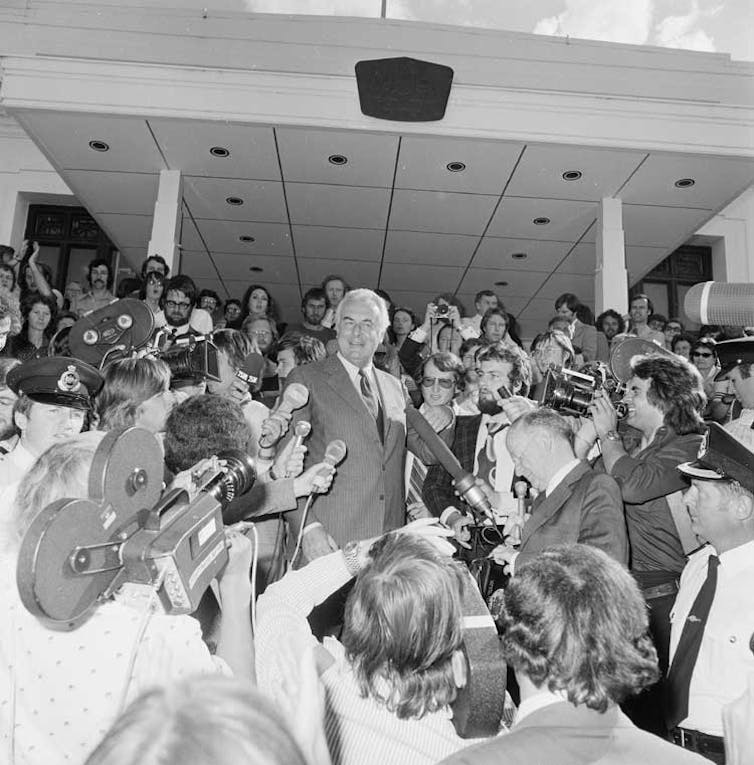
Gough Whitlam outside Parliament House on November 11, 1975. National Archives of Australia
Anne Twomey, University of Sydney
The dismissal of the Whitlam government in 1975 remains as controversial as ever. Its last chapter is to be decided in the High Court today when it hears a case brought by historian Jenny Hocking seeking public access to the letters between the governor-general, Sir John Kerr, and the queen.
Government files on the crisis were released by the National Archives under the 30-year rule and Kerr’s own private notes and reminiscences, which he deposited with the archives, have also been released.
But the letters that Kerr sent to the queen, through her private secretary, about the crisis and any replies, have not been released because they have been treated as “private” correspondence owned by Kerr, and subject to the conditions he placed on them.

Read more: Relics of colonialism: the Whitlam dismissal and the fight over the Palace letters

Conditions of access

The conditions were that they be opened 60 years after Kerr ceased to be governor-general, after “consultation” with the monarch’s private secretary and the official secretary to the governor-general. This was later unilaterally changed, on the queen’s instructions, to 50 years, but with the “approval” (rather than consultation) of the representatives of the monarch and the governor-general. It remains unclear what power the queen had to change and control conditions on access, if the documents belonged to Kerr, as it is claimed, and not the queen.
This change in the deposit conditions is critical, because we now know that the Palace is refusing access to correspondence with any of the queen’s former governors-general, even when the 50 years is up, for a period until at least five years after the death of the queen, and then only if the new monarch agrees.
This means it may never be released, or may be redacted or released only in part.

Public or private correspondence?

One problem with assessing whether the correspondence is public or private in nature is that none of the decision-makers, including the courts, have seen the letters. But experience can tell us a few things about them. First, the queen never personally engages in correspondence with her governors-general. All correspondence goes through her private secretary, and it is he (as they have always been male) who responds to the governor-general.
In times past, when the governor-general was a member of the British aristocracy or upper classes, there was a “personal” element to this correspondence. Letters from Lord Stonehaven, when he was Australia’s governor-general from 1925 to 1930, to the King’s private secretary included discussions about shooting parties, children at Eton and general gossip.
Lord Byng, when governor-general of Canada and facing his own constitutional crisis, addressed the King’s formidable private secretary, Lord Stamfordham, as “My Beloved Stamfy”. There was a mix, at that time, of personal and official roles.
But since the governor-general has been an Australian, the personal aspect has disappeared, and the correspondence became quarterly reports informing the monarch of political, economic, trade, agricultural and social conditions in Australia. The purpose was, and remains, to ensure the monarch is well informed and can therefore more effectively fulfil his or her role with respect to Australia.

Read more: Australian politics explainer: Gough Whitlam's dismissal as prime minister

In addition, there was an obligation on the governor-general to explain any exercise of a power that was done without, or contrary to, ministerial advice, such as refusing a dissolution or dismissing a government. This was strictly enforced.
It is therefore clear, and accepted by the parties, that the correspondence was entered into by Kerr and the queen’s private secretary, as part of their official functions. It was not “personal” in the sense that it concerned family or social matters. It was only personal in the sense that Kerr was writing to the queen personally about how he had fulfilled his functions as her representative. Yet, in doing so, he was fulfilling an official function of the office.

Who owns property in the letters?

The Archives Act makes a distinction between “Commonwealth records”, which are “property of the Commonwealth” and the records belonging to private individuals. So the question is, who owns the “property” in the letters? This raises consideration of who owns the piece of paper the letter is written on, who holds copyright in the letter, whether the sender or recipient owns the letters (and any copies they kept), the capacity in which the letters were written and who currently possesses the letters.
The question for the High Court is which of these factors are relevant or decisive when reading the term “Commonwealth records” in the context of the entire Act, including its purpose of preserving and giving public access to the nation’s historical records.


In the past, some governors-general had taken these letters with them on leaving office. If this indicated they believed they owned the letters, is this enough? Belief would not normally be enough to transfer ownership in a document written by an officer of the Commonwealth in an official capacity.
The Archives Act also recognises that Commonwealth records may end up in private hands, and when private collections are deposited with the archives, any documents within that collection that are “Commonwealth records” are to be treated as such.
This means they must be kept confidential for the requisite period (which has been progressively reduced from 30 years to 20 years) and publicly released if not subject to other exemptions, regardless of any conflicting conditions applied by the depositor.

What is at stake?

If correspondence between the governor-general and the queen is treated as “private” records, rather than Commonwealth records, significant risks arise.
First, this means that whoever inherits the property of the governor-general could sell these records to the highest bidder, at any time, without any secrecy limits or government control. It could be sold to a media organisation that prematurely publicises and sensationalises the letters for profit, or to a private collector who never makes the letters public.
Second, where the documents have been deposited with the archives as a “private” collection, and made subject to conditions that they not be released without the approval of the monarch’s private secretary, they may never be released, or released only in a limited and misleading form.
In both cases, there is a significant risk that Australians will be denied access to, and understanding of, not only one of the greatest political crises in Australia’s history, but how the highest offices in the land actually operate in our system of government. It is hard to believe the Archives Act could be interpreted as operating in a manner that would deny Australians control over and access to such important records of their history.The Conversation
Anne Twomey, Professor of Constitutional Law, University of Sydney
This article is republished from The Conversation under a Creative Commons license. Read the original article.

Sunday, January 26, 2020

Australia Day Honours are a closed book

A bit of interest today in transparency amid controversy over decisions on honours awards by the Australia Day Council .

Are decisions or any other documents held by the Council Secretariat (staff in the Office of the Governor General) subject to FOI?

Nope.

 This from my blog in 2013: 
"The High Court in Kline v Official Secretary to the Governor General [2013] HCA 52) ruled that documents concerning the operation of the Honours system are not within scope of the Freedom of Information Act. The decision ends a long running legal tussle regarding interpretation and application of s 6A which places the Official Secretary's office (among its other support functions, it is the Australian Honours and Awards Secretariat) outside the operation of the act "unless the document relates to matters of an administrative nature."
 More here https://bit.ly/2OeTd5J

Nothing has changed since. 

Calls for FOI reform on a wide range of fronts have got nowhere.

Seven years of coalition government and the most notable contribution to FOI in that time is the eventually unsuccessful attempt in 2014 to abolish the Office of Australian Information Commissioner.

Among the mostly uncontroversial awards was the well deserved Order of Australia OA for Fiona McLeod SC, the Chair of the Accountability Round Table and a former Chair of Transparency International Australia and the Open Government Forum, among many other wonderful accomplishments. Congratulations Fiona.

Have a thoughtful Australia Day.

Monday, December 30, 2019

Andrew Podger on Thodey and the government response


Report on public service overhaul a good start, but parliamentary inquiry is needed


The Morrison government has rejected any recommendations that would strengthen the independence of the public service. AAP/Mick Tsikas
Andrew Podger, Australian National University
The final report of the Independent Review of the Australian Public Service is much more substantial than its interim report. That is hardly a high hurdle, but its 18-page bibliography suggests considerable reflection beyond the (mostly disappointing) submissions and commissioned papers.
However, the report still has an excessive amount of rhetoric and is not an easy read.
Broadly, its themes are:
  • a united service
  • partnerships beyond the APS
  • embracing new technology
  • investing in people and capability
  • a more dynamic and responsive operational model
  • improved leadership and governance.
There are many sensible recommendations, but detail is often missing and analysis weak. Some recommendations reveal a surprising lack of understanding of the public sector.
The central theme of a “united” service is overdone, notwithstanding the case for greater coordination today. The APS does not need “an inspiring purpose and vision” – the first objective set out in the Public Service Act 1999 is clear. It is:
to establish an apolitical public service that is efficient and effective in serving the Government, the Parliament and the Australian public.
The APS Values also define the role of the APS as an institution. The review might have made more of the High Court’s references to these in confirming the constitutional standing of the APS.

Read more: View from The Hill: Morrison won't have a bar of public service intrusions on government's power

The review is right to press for a better coordinated service today, retreating from the late 1990s devolution under the new public management model. That Australia went too far is very clear (particularly on pay and conditions). Public expectations in light of modern technology are also demanding much greater connectivity today.
But the review goes too far the other way. The APS performs a wide range of functions, each requiring specialist expertise.
The Secretaries Board is not like a private sector board. Cabinet and ministers are the primary decision-makers under the Constitution, and secretaries’ first responsibilities are within their portfolios, serving and advising their ministers and delivering services and implementing government policies. At the centre it will always be primarily the responsibility of the Australian Public Service Commission (APSC) and the Department of Prime Minister and Cabinet (PM&C) to do the administrative coordination, though necessarily in close consultation with secretaries and other agency heads.
Perhaps the most valuable contribution of the report relates to the application of new technology. It makes a convincing case for very substantial new capital investments over many years and for increasing allocations for minor capital investment. These, and the associated building of skills, are necessary for more citizen-centred services and a more digitally enabled administration.
The report is also on the right track with several other themes:
  • invest in people and strengthen capability
  • reduce hierarchy and promote more dynamic teamwork across the service
  • improve governance and leadership, including by firmer merit-based approaches to appointments.
But the report pulls its punches about the causes of the problems. It could have been clearer about what needs to be fixed.
Why has strategic policy advising capacity declined and other expertise been lost? Why has evaluation activity and skills dropped away? Why has the APS become more risk-averse and hierarchical?
Thankfully, the Thodey Report does include recommendations aimed at strengthening the standing of the APS and clarifying relations with the government and the parliament. These include:
  • the accountability and integrity of ministerial staff
  • secretary and other agency head appointments and terminations, the respective roles of the APSC and secretary of PM&C, and the appointment of the APS commissioner.
Even if I disagree with some aspects, the report at least puts these things firmly on the table (see also my recent Parliamentary Library lecture).
On several other matters there is a disappointing lack of detail, despite the report often pointing in the right direction. These include:
  • The discussion of the APS Values ends up proposing some new statement of “principles” to supplement the values. What is needed is to recast the values to reflect more directly the APS’s unique institutional role (and return “merit” to the list).
  • The important discussion of place-management fails to set out the architecture required at community and regional levels, and how it might link with state government service delivery.
  • The discussion on budgeting rightly highlights the importance of adequate capital investment, but overlooks the equally important issue of how running costs should be financed (without crude efficiency dividends).

The government’s response

Michelle Grattan correctly summarised the response as solidifying the power of the prime minister and rejecting any recommendations that would strengthen the standing and independence of the APS.
Sadly, the result will be that many of the recommendations ostensibly “agreed” by the government will not succeed because the drivers behind the reduced capability of the APS (and its risk-averse and hierarchical culture) will remain and will probably grow stronger.
The repeated references in the response to “consistent with the Secretaries Board’s advice” when a recommendation was not agreed is both odd and worrying. If the advice was as claimed, I can only surmise that it demonstrates to the rest of the APS the leadership’s lack of frank and fearless advice. Surely the Secretaries Board supports a more uniform pay and conditions framework, and a more robust process for their own appointments and terminations?
On a positive note, the government agrees with the majority of the recommendations, particularly those relating to digital technology. Most of the responsibility for proceeding will lie with the APS itself. Whether the government will eventually sign up to the capital funding the head of the review, David Thodey, believes will be needed (initially at least A$100 million a year after the audit is complete) is uncertain.
The government has so far agreed only to A$15 million over two years to start work on all the agreed recommendations.

Machinery of government

Aspects of the prime minister’s earlier announcement about machinery-of-government changes have merit. They include:
  • reducing the separation of policy and administration by replacing DHS with an executive agency within the DSS portfolio
  • re-establishing strong links between education, employment and training
  • separating energy from the environment, recognising that the tensions between these major functions should be settled in cabinet.
But the failure to recognise such changes only work if aligned to ministry arrangements is extraordinary. The 1987 introduction of mega-departments was only partly to do with economies of scale. Mostly it was about streamlining cabinet: allowing cabinet to be small and manageable while still having every (portfolio) department represented, and allowing portfolio ministers to exercise, with their assistant ministers, more responsibility including over resource allocation.

Read more: Morrison cuts a swathe through the public service, with five departmental heads gone

The prime minister’s claim that his restructuring will ensure “congestion busting” and a much improved “line of sight” is contrived and almost certainly illusory. It cannot be achieved without “line of sight” between ministers and the public service. The new infrastructure department will have eight ministers, four in cabinet, several with responsibilities in other portfolios, and around 80 ministerial staff. This is hardly a recipe for a stronger focus on serving the public.
We do not know what, if any, advice the APS provided about these changes. My fear is that APS expertise in such matters has deteriorated greatly in recent years.
Apart from this misalignment between the ministry and the machinery of government, some of the details of these changes are wanting. In particular, there remains a serious problem about the separation of Medicare Australia from health policy.

Where to from here?

The Morrison government’s pronouncements over the past fortnight confirm its lack of real interest in the public service as an institution. Sadly, it seems much of the conservative side of politics has lost the sort of support of our institutions that Menzies and other traditionalists exemplified.
Equally, it would be wrong to rely on the other side of politics to pursue the directions in the Thodey Report that the Morrison government has ruled out. Not only would this ignore Labor’s contribution over the years to the current sorry state of affairs, but it would set up for partisan debate the appropriate governance and degree of independence of the APS, something inimical to what fundamentally must be non-partisan.
Instead, we need the parliament to intervene, if not in the immediate light of the Thodey Report and the government’s response, then before or shortly after the next election. A Senate select committee might be asked to undertake an inquiry into the relationship between the APS, the government and the parliament. It should examine:
  • the constitutional role of the APS and how this is reflected in the Public Service Act
  • the distinctive values of the APS in line with its constitutional role
  • the corresponding distinctive values of other components of the Commonwealth, including within the executive, the legislature and the judiciary
  • the processes for appointing and terminating secretaries and other APS agency heads
  • the respective roles of the APS commissioner and secretary of PM&C
  • the roles and responsibilities of secretaries, senior executives and the Secretaries Board
  • the Members of Parliament Staffing Act and associated accountability arrangements.
This inquiry should consider Thodey’s recommendations and other options, and be asked to come up with its own concrete recommendations.The Conversation
Andrew Podger, Honorary Professor of Public Policy, Australian National University
This article is republished from The Conversation under a Creative Commons license. Read the original article.