Search This Blog

Showing posts with label Archives. Show all posts

Sunday, May 31, 2020

High Court ruling on 'Palace letters' case paves way to learn more about The Dismissal - and our Constitution


National Archives of Australia

Anne Twomey, University of Sydney
 

The High Court has ruled that Sir John Kerr’s correspondence with the queen comprises “Commonwealth records”. This means access to them is now in Australian hands and can no longer be vetoed by the private secretary to the queen.
This correspondence, which includes Kerr’s briefings to the queen on the political crisis prior to the dismissal of the Whitlam government on November 11 1975, and his explanation to her afterwards of why he exercised this power, have so far been kept from public view.

Read more: Explainer: what is the 'palace letters' case and what will the High Court consider?

The High Court’s decision opens the possibility that we will finally see the last pieces of factual evidence about The Dismissal – revealing the concerns and reasoning of the governor-general, as events occurred, without the gloss of hindsight.
It could even allow this festering wound in our political history to be healed, once all the information has been revealed. But it depends now on what the National Archives does next.

How were these letters treated until now?

Until now, the National Archives has claimed all correspondence it holds between governors-general and the queen, even when written in their official capacities, is “personal” and not a “Commonwealth record”.

This means there was no legal obligation on the National Archives to provide public access to these letters. Instead, the National Archives had stated it could only release these documents in accordance with the conditions placed on them by the person who lodged them with the National Archives.
But it let those conditions be changed on the instructions of the queen in 1991 so that her private secretary and the secretary of the governor-general held a veto over the release of any such correspondence.

Read more: Australian politics explainer: Gough Whitlam's dismissal as prime minister


Professor Jenny Hocking. AAP/James Ross

In the case brought by academic Jenny Hocking against the National Archives, the High Court held by a majority of six to one that the letters between Sir John Kerr and the queen were created, received and held as institutional documents by the “official establishment of the Governor-General” before being transferred to the National Archives by the official secretary to the governor-general in his official capacity. This level of official control over them was enough to make them “Commonwealth records”, even if the governor-general still held ownership rights over them (which the majority said it did not need to decide).

In their joint judgment, Chief Justice Kiefel and Justices Bell, Gageler and Keane said they could not see how the correspondence could be described, however “loosely”, as “private or personal records of the Governor-General”.

They said it could not be supposed that Kerr could have taken the correspondence from the governor-general’s official establishment and destroyed or sold it.

Justice Gordon thought even if Kerr did have property rights in the original documents, he gave up any claim to them when they were deposited with the National Archives. Justice Edelman agreed the correspondence between the governor-general and the queen was “created or received officially and kept institutionally”.

Only Justice Nettle concluded these letters were personal communications between Kerr and the Queen, and were not Commonwealth records.

Does this mean we get to see the letters now?

The court did not order that the letters be publicly released. Instead, it ordered the director-general of the National Archives reconsider Jenny Hocking’s request for access to the correspondence held by the archives, treating them as Commonwealth records.

Section 31 of the Archives Act 1983 requires the National Archives to give public access to any Commonwealth record that it holds that is within the open access period and is not an “exempt record”.

The correspondence between Kerr and the queen has been in the “open access period” since 2006/2007. The only question that remains is whether the director-general will now claim that the correspondence is comprised of “exempt records”.

Section 33 of the Act lists a number of exemptions. These include documents that could reasonably be expected to cause damage to international relations, or where disclosure of matters in the record would constitute a breach of confidence.

The damage that might be caused by the release of documents necessarily diminishes over time. So even if these exemptions are claimed, consideration would have to be given to whether they remain applicable, given the age of the documents.

The director-general of the National Archives responded to the High Court’s decision by stating the “National Archives is a pro-disclosure organisation” that operates on the basis of making records publicly available “unless there is a specific and compelling need to withhold it”.
It will be interesting to see what “compelling” needs it might identify.

Are there any wider implications of the decision?

The High Court’s decision will also affect the release of correspondence by other governors-general. The release of Lord Casey’s correspondence with the Queen was recently blocked by Buckingham Palace, which stated it would refuse access to any correspondence with the queen until at least five years after her death, and then only if the private secretary to the new monarch agrees. That veto has now been destroyed by the High Court.

So not only is Kerr’s correspondence with the queen liable to be opened, but also the correspondence by all other governors-general with the queen, when it is in the “open access period” and subject to any exemption.

That may mean we get a better idea of how the roles of the governor-general and the queen operate under our Constitution, which would be a good thing.The Conversation


Anne Twomey, Professor of Constitutional Law, University of Sydney
This article is republished from The Conversation under a Creative Commons license. Read the original article.

Monday, March 09, 2020

Pass the hot parcel when questions are raised about 40 years of records in the bin

The testimony in a senate committee hearing on the Sports Rorts affair that retiring Secretary of the Department of Health Glenys Beauchamp had destroyed all of the notes and notebooks from her public service career at the end of January led to further inquiry in Senate estimates last week. The hot potato of course was the notes if any that had been kept then destroyed about meetings concerning the tortuous decision making on community sports grants.

Senate Estimates on this bore passing resemblance to pass the parcel but there was no prize for anyone when the music stopped-for the moment at least.

In short:

Australian Public Service Commissioner Peter Woolcott said he hadn't carried out an investigation into the matter as requested by Senator Gallagher because he didn't have authority and the Attorney General's Department not the Commission was the agency responsible for the Archives Act. Senator Gallagher noted the APSC website had a lot of information about record keeping. Woolcott said this was all to do with the broader issue of integrity and the APS Code of Conduct but "I have no room to investigate Ms Beauchamp at this point." 

The Attorney General's Department couldn't say one way or the other whether destruction of the notes and notebooks could give rise to an offence under the Archives Act, noting that destruction of records in accordance with "a normal administrative practice" was exempt from the offence provision, and flagged that the Archives office was to be heard later in the day.

 When the Archives office, no doubt the best placed to throw light on it all, finally got the call at 10.45 pm, none of the senators who pursued the issue earlier in the day asked a question about it in the 15 minutes devoted to Archives. Archives will no doubt get a chance through questions on notice to express a view in light of  published guidance on the matter but now Ms Beauchamp has left the service and the records no longer exist it seems unlikely to go any further.

What message this conveys to public servants about record keeping generally is another matter, just as Mr Woolcott prepares for a service wide training initiative on integrity. Quite a challenge but a ready made case study perhaps?

 Senator Gallagher the opposition shadow public service minister has written to the Attorney General asking him to investigate the destroyed notes.
“It seems all very convenient that no official records are available from a key meeting of senior officials – urgently convened to discuss the management of political interference in the allocation of sports grants and that of the three officials present at that meeting only former CEO of Sport Australia, Ms Palmer, can recall it,” Gallagher said.“I have referred the matter of the destruction of records to the attorney general following the advice of the Public Service Commissioner. As a commonwealth public servant the making and keeping of records is not a discretionary act.”

The long version of what transpired in Estimates is in these extracts from the Hansard transcripts:

Tuesday, February 04, 2020

Another closed book: letters from Governor General to the Queen 45 years ago?


Explainer: what is the 'palace letters' case and what will the High Court consider?


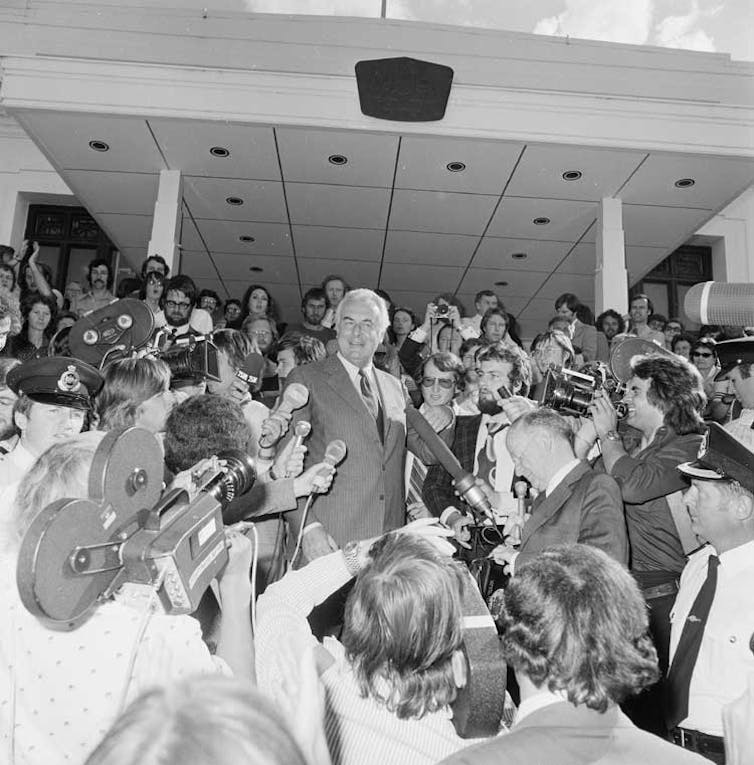
Gough Whitlam outside Parliament House on November 11, 1975. National Archives of Australia
Anne Twomey, University of Sydney
The dismissal of the Whitlam government in 1975 remains as controversial as ever. Its last chapter is to be decided in the High Court today when it hears a case brought by historian Jenny Hocking seeking public access to the letters between the governor-general, Sir John Kerr, and the queen.
Government files on the crisis were released by the National Archives under the 30-year rule and Kerr’s own private notes and reminiscences, which he deposited with the archives, have also been released.
But the letters that Kerr sent to the queen, through her private secretary, about the crisis and any replies, have not been released because they have been treated as “private” correspondence owned by Kerr, and subject to the conditions he placed on them.

Read more: Relics of colonialism: the Whitlam dismissal and the fight over the Palace letters

Conditions of access

The conditions were that they be opened 60 years after Kerr ceased to be governor-general, after “consultation” with the monarch’s private secretary and the official secretary to the governor-general. This was later unilaterally changed, on the queen’s instructions, to 50 years, but with the “approval” (rather than consultation) of the representatives of the monarch and the governor-general. It remains unclear what power the queen had to change and control conditions on access, if the documents belonged to Kerr, as it is claimed, and not the queen.
This change in the deposit conditions is critical, because we now know that the Palace is refusing access to correspondence with any of the queen’s former governors-general, even when the 50 years is up, for a period until at least five years after the death of the queen, and then only if the new monarch agrees.
This means it may never be released, or may be redacted or released only in part.

Public or private correspondence?

One problem with assessing whether the correspondence is public or private in nature is that none of the decision-makers, including the courts, have seen the letters. But experience can tell us a few things about them. First, the queen never personally engages in correspondence with her governors-general. All correspondence goes through her private secretary, and it is he (as they have always been male) who responds to the governor-general.
In times past, when the governor-general was a member of the British aristocracy or upper classes, there was a “personal” element to this correspondence. Letters from Lord Stonehaven, when he was Australia’s governor-general from 1925 to 1930, to the King’s private secretary included discussions about shooting parties, children at Eton and general gossip.
Lord Byng, when governor-general of Canada and facing his own constitutional crisis, addressed the King’s formidable private secretary, Lord Stamfordham, as “My Beloved Stamfy”. There was a mix, at that time, of personal and official roles.
But since the governor-general has been an Australian, the personal aspect has disappeared, and the correspondence became quarterly reports informing the monarch of political, economic, trade, agricultural and social conditions in Australia. The purpose was, and remains, to ensure the monarch is well informed and can therefore more effectively fulfil his or her role with respect to Australia.

Read more: Australian politics explainer: Gough Whitlam's dismissal as prime minister

In addition, there was an obligation on the governor-general to explain any exercise of a power that was done without, or contrary to, ministerial advice, such as refusing a dissolution or dismissing a government. This was strictly enforced.
It is therefore clear, and accepted by the parties, that the correspondence was entered into by Kerr and the queen’s private secretary, as part of their official functions. It was not “personal” in the sense that it concerned family or social matters. It was only personal in the sense that Kerr was writing to the queen personally about how he had fulfilled his functions as her representative. Yet, in doing so, he was fulfilling an official function of the office.

Who owns property in the letters?

The Archives Act makes a distinction between “Commonwealth records”, which are “property of the Commonwealth” and the records belonging to private individuals. So the question is, who owns the “property” in the letters? This raises consideration of who owns the piece of paper the letter is written on, who holds copyright in the letter, whether the sender or recipient owns the letters (and any copies they kept), the capacity in which the letters were written and who currently possesses the letters.
The question for the High Court is which of these factors are relevant or decisive when reading the term “Commonwealth records” in the context of the entire Act, including its purpose of preserving and giving public access to the nation’s historical records.


In the past, some governors-general had taken these letters with them on leaving office. If this indicated they believed they owned the letters, is this enough? Belief would not normally be enough to transfer ownership in a document written by an officer of the Commonwealth in an official capacity.
The Archives Act also recognises that Commonwealth records may end up in private hands, and when private collections are deposited with the archives, any documents within that collection that are “Commonwealth records” are to be treated as such.
This means they must be kept confidential for the requisite period (which has been progressively reduced from 30 years to 20 years) and publicly released if not subject to other exemptions, regardless of any conflicting conditions applied by the depositor.

What is at stake?

If correspondence between the governor-general and the queen is treated as “private” records, rather than Commonwealth records, significant risks arise.
First, this means that whoever inherits the property of the governor-general could sell these records to the highest bidder, at any time, without any secrecy limits or government control. It could be sold to a media organisation that prematurely publicises and sensationalises the letters for profit, or to a private collector who never makes the letters public.
Second, where the documents have been deposited with the archives as a “private” collection, and made subject to conditions that they not be released without the approval of the monarch’s private secretary, they may never be released, or released only in a limited and misleading form.
In both cases, there is a significant risk that Australians will be denied access to, and understanding of, not only one of the greatest political crises in Australia’s history, but how the highest offices in the land actually operate in our system of government. It is hard to believe the Archives Act could be interpreted as operating in a manner that would deny Australians control over and access to such important records of their history.The Conversation
Anne Twomey, Professor of Constitutional Law, University of Sydney
This article is republished from The Conversation under a Creative Commons license. Read the original article.
Sunday, October 23, 2016

Call to arms: Australians should own their own history.

This post four years ago commented on the cringe-worthy news that Governor General's official correspondence with the Queen after the event is packed off to archives at Buckingham Palace and beyond reach of Australian disclosure laws.

Now it emerges that GG Kerr's 1975 correspondence with the Palace that he designated personal is 'private' in the hands of National Archives Australia, not part of official Commonwealth records and subject to normal archives disclosure rules, is embargoed until at least 2027, and the Queen's private secretary holds a final veto over release even after that date.

Shoulders to the wheel folks-If you can contribute to the out of pockets for this legal challenge to quaint ancient world notions of British crown privilege, it's a worthy cause. 

$17k and counting....


Monday, January 04, 2016

Archives cabinet documents release -1990-1991 still too recent for some

Plenty to fill columns in the media on New Years day with the annual cabinet document release by Archives Australia, this year for 1990-1991, the last years of the Hawke government.


Not widely reported was that the release comes with the usual mysteries concerning 'the small amount of material" withhheld. Who knows at what point these elements of ancient history become publicly known and acknowledged ancient history. 


Three cabinet documents are withheld in their entirely-not even the title can be disclosed- because disclosure"would damage Australia's security, defence or international relations – s33(1)(a)."


Twenty six documents are released with redactions ("Open with exception"-OWE) based on this and other provisions in
section 33 of the Archives Act.

Gabrielle Chan in The Guardian writes about the document released with redactions ("Open with exceptions"-OWE)  concerning the Coronation Hill mining lease held by BHP in an area that is now a part of Kakadu national park in the Northern Territory. 


The Submission 7994 (Response to Resource Assessment Commission (RAC) inquiry into use of resources of Kakadu Conservation Zone - Decision 15315) is the only OWE document I can find published online with reasons for deletions. Pages 53-56 containing "information provided by the Attorney General's Department relating to matters that could be subject of legal proceedings" are redacted. 


That advice was provided in 1991. According to Archives the "information continues to be sensitive despite the passage of time and the information has enduring confidentiality. The public's interest to know about the decisions of government is outweighed by the need for the information to be protected  from release because of ongoing sensitivities.Therefore it would be contrary to the public interest for information to be disclosed."


(Counterpoint: In 1979 the Senate Standing Committee recommended against the inclusion of a legal professional privilege exemption in the Archives Bill, to no avail.  Seventeen years ago the Australian Law Reform Commission recommended the professional privilege exemption should be removed from the Archives Act, to no avail. Quite a few other ALRC recommendations in that report were not acted upon. Records law and practice is an area that needs updating, not just on the "open/closed' scale but in 2016, in light of technological developments and the move towards 'digital only' records.)

(Correction: at least two other documents OWE and published online with reasons for refusal are New Policy Proposals for the 1991 Budget (amounts for funding new activities of the Australian Secret Intelligence Service redacted on grounds information is still sensitive and disclosure "could compromise future activities and impair its ability to carry out its statutory functions") and Petroleum Resource Rent Tax-revenue sharing (one page redacted on legal privilege grounds, the reasons given in the exact terms used for redaction of advice from the Attorney General's Department in Submission 7994 mentioned above.)


Other head scratch redactions from documents now 24-25 years old (apart from redactions to a raft of security and intelligence related documents) are two budget documents one of which is about revenue sharing the Petroleum Resource Rent Tax; Threats against civil aviation; Australia's policy approach to Papua New Guinea; Australia-Taiwan relations; Australia-Iran relations - control of Iranian students in Australia; and British atomic tests - personal compensation for aboriginals. 


From the Archives website-not easy to find from the home page IMO. 

Friday, January 02, 2015

Annual release of cabinet records - our ancient history not all fit for public consumption

The 1988-1989 cabinet records released on 1 January provide plenty of interest for the buffs and interesting pickings for the mainstream at a slow news time of the year.

As to the admittedly small amount of information still withheld after all these years, a plus that no document is withheld in its entirety.

But still plenty of room for head scratching.

What passes for usual (see last year), parts of various documents concerning Antarctica are withheld. All interested parties no doubt guess those parts don't sit well with our sovereignty claim. 

What officials judge shouldn't be revealed about what cabinet and senior officials knew then concerning the South Pacific, Papua New Guinea, Indonesia and China is another matter, probably to do with spooks and intelligence matters. 

Clearly that's the case with withheld parts of "People's Republic of China intelligence services activities in Australia" and "Eastern European and Cuban intelligence activities in Australia." As to the withheld part of the title of the submission "Measures to improve Australia's High Frequence (HF) Signal Intelligence Capability.." - any guesses?

Parts of submissions still relevant to the current Mr Fluffy asbestos problem in the ACT and NSW are disclosed but other parts of Memorandum 6034 and Submission 6037 on the subject are withheld for a range of reasons. Including yes, believe it or not, because of likely damage Australia's security, defence or international relations.  legal privilege not outweighed in the judgment of officials by the public interest in disclosure.

Parts of "Cape York spaceport – Commonwealth support" are withheld because of damage to security, defence or international relations.

You have to wonder at what point officials are comfortable for our ancient history to become our publicly known and acknowledged ancient history.

From National Archives Australia, the section dealing with withheld records:

Thursday, January 02, 2014

Annual cabinet papers released-alas, still plenty of dark secrets

Communications Minister Malcolm Turnbull may have choked for a moment on his breakfast cereal when browsing the list of 1986/87 cabinet papers released and withheld.

Particularly at the news that Cabinet Memorandum 4456 "Australian intervention by affidavit in UK Attorney-General v Heinemann and Peter Wright", the famous Spycatcher case, remains secret in its entirety all these years later on the grounds that disclosure "could reasonably be expected to cause damage to the security, defence or international relations of the Commonwealth."


Turnbull in 1986 took on and won against the might of the Thatcher government, Wright's right to publish in Australia "The Candid Autobiography of a Senior Intelligence Officer" written while Wright was living in Tasmania after retirement from MI5. Turnbull in 1989 wrote his own account of the trial - a bargain these days at $2.98 from Amazon.  

The book contained revelations not quite up there with Edward Snowden but it was a big deal at the time. Some aspects still, according to Archives. 

The number of withheld documents this year, in line with the recent years, is small in comparison with the number released.

However you have to wonder why so many of those released needed blanket freedom of information exemption for so long- most state government laws limit the application of the cabinet exemption to 10 years although other exemptions may still then apply to protect sensitive information. No such provision in the Commonwealth act where the cabinet exemption applies until the open access period, moving towards 20 years, kicks in.

Apart from the Spycatcher memorandum, another notable withholding is Submission 4207 "Project Nulka." The Department of Defence in October 2013 was very pleased to commend the book Nulka: A Compelling Story about an Australian ship defence system that is our largest regular defence export.

In the current climate of revelations about US and Australian intelligence gathering, and difficulties in our relations with Indonesia and East Timor the withholding of all or parts of cabinet papers concerning Security and intelligence, and Foreign Affairs ("Australia–Indonesian relations – prospects and approach"; "Australia–Indonesia maritime delimitation negotiations") will lead to plenty of speculation about what is still sensitive 27 years on.
(Update: See Paul Chadwick in The Guardian for an interesting comparison of issues of the 80's and current Snowden related matters. Welcome back to journalism Paul.)

Again this year there are a number of partial withholdings about Antarctica-probably confirming what most who take an interest in the subject know, that Australia's sovereignty claims are shaky if not quite as thin as a melting ice shelf, but we wouldn't want to let on at any time if we can help it.

The list of withheld documents follows. 

OWE – open with exception - means partial release, 'Closed', wholly withheld. 
Section 33 (1)(a) of the Archives Act provides exemption for "information or matter the disclosure of which under this Act could reasonably be expected to cause damage to the security, defence or international relations of the Commonwealth." As with other exemptions in this part of the act there is no public interest test. Decisions to withhold are subject to review by the Administrative Appeals Tribunal

Friday, January 04, 2013

Some cabinet records still too sensitive for release 27 years on

The annual release by the National Archives Authority on 1 January of cabinet papers covered more than 700 records from 1984-85, the first two years of the Hawke government. 

You have to seriously question why some of these records are locked up tight for 27 years or so. Sure they were documents submitted to cabinet but many contain nothing of sensitivity. Most of the state freedom of information laws include an exemption for cabinet documents for 10 years. Beyond that other exemptions may apply depending on content and the effect of disclosure.The Commonwealth should follow this lead.


And we can only muse over what is still deemed too sensitive to release after all this time. Archives announced that "a small amount of material" was withheld from 30 of the papers released. One submission was wholly withheld, including its title. 


I haven't had a chance to look closely at what was withheld and the reasons except

information withheld from Cabinet Submission 3249 - Review of Australian honours system - Decision 6667, September 1985. 

The timing, just weeks after the decision by the Federal Court in the Kline case on FOI access to contemporary documents about the operation of the Honours system was exquisite.

The Archives summary was that disclosure of the redacted material would constitute a breach of confidence and the unreasonable disclosure of information relating to the personal affairs of any person (including a deceased person). (Archives Act s 33(1)(d) and (g)).

But the actual
notice of decision reveals that deleted material now more than 27 years old contained information from "personal and private correspondence between the Governor General  and Her Majesty The Queen." As such documents are not subject to the Archives Act, "the public disclosure of this information would constitute a breach of confidence."


The personal affairs exemption claim seems to be based entirely on the assertion that the Governor General and The Queen were engaged in "personal communication."
Really? It sounds official not personal to me. In any event the nature of the information seems almost certain to fail the personal affairs ("matter of private concern") test.


As Professor Anne Twomey has
pointed out Australia doesn't control records relating to Governor-General/ Monarch communication.  Under UK law, disclosure of communications with the Queen and other members of the Royal household are absolutely prohibited from release for a minimum of 20 years from the time they are made, and then for the continuing lifetime of the relevant member of the royal family, plus an extra five years after their death. 


It's controversial in the UK, and in this neck of the woods hardly in keeping with standards of transparency we might expect from our head of state or her representative.

The absence of a public interest test in
most exemption provisions of the Archives Act is a significant gap in the law regarding access to historical documents.

As to other records, most were withheld on the basis of an exemption claim under section 33(1)(a) of the Archives Act, "withheld to protect Australia's security, defence or international relations." Presumably its mainly spook material. But you have to wonder just how long is long enough before we can know all that cabinet knew at the time decisions were made about such matters as Long-term plans for Antarctic programs, Antarctic airfields, a proposed Aeroflot office in Australia, and International atmospheric experiments in Northern Australia, to name just a few.

Parts of three records, Review of Offshore Constitutional Settlement – petroleum and minerals, Review of Offshore Constitutional Settlement – titles legislation, and Briese allegation relating to the conduct of Mr Justice Murphy were withheld on grounds of legal privilege, something the ALRC recommended years ago should be removed as an exemption claim for archived documents.

Friday, January 27, 2012

Names of "no gong, thanks" crowd unlikely to surface in Australia

Dahl-Charlie and the Chocolate..
Lewis-Narnia and all that..
Thanks to reader Andrew for drawing attention to the release in the UK, in response to a Freedom of Information application by the BBC, of the names of those who  declined a Queen's honour between 1951 and 1999, and who have since died-Roald Dahl and CS Lewis for two. "Until now, the information was so secret it was not included in official papers released under the 30-year rule," according to the BBC.

None of the 277 people on the list (pdf courtesy of BBC) are identifiable Australians-Imperial honours were the go until the Whitlam government abolished them and created the Order of Australia in 1975-although the request may have been limited to British names.

What's the likely story here?

Documents concerning consideration of names for submission for Imperial awards, up to 1974, and the later records held by the Office of the Governor General concerning the Council of the Order of Australia, the first of which are now 37 years old, in theory, should be well into open access (now after 20 not 30 years) and available from National Archives Australia. However unlike the UK, where personal information protections in the FOI act relate only to information concerning "a living individual," there is a hurdle: our archives act (s 33(1)(g)) qualifies the right to access through a provision that protects "information or matter the disclosure of which .. would involve the unreasonable disclosure of information relating to the personal affairs of any person (including a deceased person.)"

I don't know whether anyone has had a crack at this. Or sought records still held by the Office of the Governor General under the Freedom of Information Act. On the latter, probably not, given that the current battle over whether guidelines for awards are documents of "an administrative nature" subject to the act seems to be a first. A second hurdle once over the first would be whether the FOI act personal privacy conditional exemption s 47F applies. 

Two significant differences to the Archives Act: the FOI definition of personal information makes no reference to a person as living or deceased. And section 47F includes an additional public interest test, not found in archives legislation (don't ask me!). I'd expect disclosure under FOI of names of those who declined an award would be unreasonable in the absence of consent (where practicable, from next of kin in the case of a deceased person) and in any event that public interest considerations in favour of release would not be strong.

But otherwise idle researchers out there, your time starts now!


Tuesday, January 03, 2012

Head-scratchers in secrecy claims for documents 30 years old

From NAA website
The National Archives Authority released Cabinet papers for two years on 1 January, as part of the transition from the 30 to 20 years secrecy rule, comprising 800 of the papers considered and discussed by the Fraser and Hawke Cabinets in 1982 and 1983. The media coverage of what was released focuses, rightly, on some of the juicy bits. What wasn't released sparks interest here.

  While a relatively small amount of information in the overall scheme of things (and about the same proportion as last year), you have to wonder whether excessive secrecy rather than legitimate well based concern about the effect of disclosure is at work here.

The titles of three documents withheld in their entirety isn't disclosed and parts of 25 others have been redacted. The "reasons" given are simply assertions of a claim for exemption under the Archives Act 1983. The NAA shorthand descriptions of two exemptions (section 33(1)(b), 33(1)(c)) leave out important elements of the exemption provision itself.

Some redactions that prompt more than the usual amount of head-scratching, bearing in mind the documents are 29-30 years old, include
  • To protect Australia’s security, defence or international relations. Six documents relate to Antactica including "Australian policy objectives in Antarctica." Then there is  "Overview of Defence counter-terrorist capability", "Australian policy towards China" and "Future Australian interest in Christmas Island".
  • Withheld because release would have a substantial adverse effect on the financial or property interests of the Australian government or a government institution. "New policy proposals 1982-1983 - Treasury" (!!) (The exemption contains a public interest test- disclosure would not, on balance, be in the public interest.)
  • To protect information because its release would adversely impact on the business, commercial or financial affairs of a person, organisation or undertaking." Report of Mr A F Smith on the Office of the Deputy Crown Solicitor (DCS), Perth."  (!!!!!)

Tuesday, March 29, 2011

Secrecy still trumps, mostly, for E Timor Sitreps 35 years on

The subbie who wrote the headline"Secrets of E Timor invasion to be revealed" to the report of an Administrative Appeals Tribunal decision in today's Sydney Morning Herald was way ahead of the game.  President Downes in Clinton Fernandes and National Archives of Australia [2011] AATA 202 found 250 lines spread across 42  documents, all 35 years old, were not exempt as claimed under s 33 of the Archives Act. However as the Herald report revealed, even the applicant is yet to see those parts of the documents now to be released, so whether they amount to much despite the attempt to keep them secret remains to be seen. As President Downes [18] said: 
The passages which can be released are substantially passages which contain material which is not inherently confidential, where disclosure will not incidentally disclose anything that is.
Radio Australia carried the only other report today under the more accurate "New intelligence files may shed light on Balibo killings". Maybe, maybe not. According to RA
The Defence Department says 95 per cent of its claim was upheld and that it won't be appealing the decision.
The decision 

Monday, January 17, 2011

Some cabinet papers still too sensitive after 30 years

National Archives of Australia released the cabinet papers of 1980 under the 30 year rule on 1 January. Archives are moving towards open access after 20 years, but NAA didn't have resources to release the 1981 records, as required in what would have been the first step in this transition. Over 3000 documents were released, with about 25, around the same number as last year, withheld, three entirely including the subject, and parts of others.

Thursday, September 02, 2010

Balancing cabinet confidentiality and other considerations

This Federal Parliamentary Library Background Note on Cabinet confidentiality by Dr Mark Rodrigues covers the origins, history and evolution of the concept, and issues concerning leaks, the courts, parliament's rights of access, and Freedom of Information exemptions. Dr Rodrigues concludes that a harm based approach reflecting public interest considerations would strike a better balance than blanket secrecy between the need for confidentiality and the need for open and accountable government. Don't hold your breath.

It is hard to see from the annual Archives release of cabinet documents that harm to any identifiable public interest would result from release of the vast majority of what are generally unexciting cabinet submissions - without the 20-30 year wait.  What is said in the cabinet room is a different matter.

Not referred to in the Background Note is the fact that Queensland leads the country with voluntary publication on this webpage of details of some cabinet decisions at least.  As a first step to better balance, others could follow suit.

Tuesday, March 16, 2010

ALRC on secrecy No 3:assorted other issues

Other bits and pieces from the Australian Law Reform Commission Report Secrecy Laws and Open Government in Australia (posts 1 and 2 if you missed them). The  unspecified contribution to the culture of secrecy of the practice of requiring of an officer an oath that goes beyond the strict letter of the law is of particular interest. That's on top of 500 odd secrecy provisions to start with.

Senior management should be held to account
 15.13 The ALRC continues to see the benefits of including in the performance agreements of senior officers in Australian Government agencies a responsibility to ensure efficient and effective information-handling practices. As noted in ALRC 77, giving tangible incentives to staff to pay greater attention to, and to improve, an agency’s information-handling practices will increase the likelihood of cultural change.

Staff need more guidance on information handling
Recommendation 15–1 Australian Government agencies should develop and administer training and development programs for their employees, on induction and at regular intervals thereafter, about the information-handling obligations relevant to their position, including the need to share information in certain situations. Programs should also provide information about how employees can raise concerns and make public interest disclosures.

Oaths of secrecy should be limited to obligations at law
15.28 Approximately 8% of the secrecy provisions identified by the ALRC— predominantly in laws governing taxation and revenue-protection information— empower a specified person, or persons, to require officers to take an oath or make an affirmation of secrecy. Secrecy obligations may also be included in the oaths of office required for assuming certain public positions, such as the oath taken by Executive Councillors. In addition to conduct covered by these legislative provisions, some agencies have taken administrative action to require officers to sign an acknowledgement of their secrecy obligations.
15.30 The ALRC has heard anecdotally, however, that some Commonwealth employees have been asked to sign oaths that set out substantially more stringent secrecy requirements than those that apply under relevant Commonwealth laws.
15.35 In DP 74, the ALRC expressed the view that the relevant Australian Government agency should retain the discretion to administer an oath or affirmation of secrecy, in accordance with any legislative provision. However, the ALRC proposed that where an agency decides to administer such an oath, it should ensure that it is an accurate reflection of the requirements under relevant Commonwealth secrecy laws. In particular, the ALRC was concerned about the potential for oaths and affirmations to set out broader or more onerous obligations than the secrecy laws on which they are based.
Recommendation 15–2 Any Australian Government agency that administers oaths, affirmations or declarations of secrecy should ensure that these properly reflect what is required under relevant Commonwealth secrecy laws.

Changes to Archives Act
The taxation specific secrecy provision in the act [Recommendation 16–5 ], Section 33(3) should be repealed.

And current uncertainty about the relationship between the Archives Act and secrecy provisions in other acts should be removed:
Recommendation 16–6 The Archives Act 1983 (Cth) should be amended to provide that the public access provisions of the Act override any secrecy provisions that would otherwise apply.

Tuesday, February 23, 2010

Archives to stay open..in a fashion

After posting a Boo, hiss last November over Government plans to close National Archives' offices in Darwin, Adelaide and Hobart, pleased to see an "archivists power" led movement resulted in a roll-over of sorts.  University of Sydney FOI staffer Anne Picot features in the 7.30 Report story on the win.

Wednesday, November 18, 2009

Boo, hiss....

From the newsletter of Sydney's terrific Gleebooks, a note from the historian and archivist Baiba Berzins:
"The National Archives of Australia has announced that it will be closing its regional offices in Darwin (in 2010), Adelaide (2011) and Hobart (repository 2010 and reading room 2012). It is proposed to relocate the records to Sydney and Melbourne. This is heartbreaking for Indigenous people in the Northern Territory because the NAA office in Darwin houses the records relating to the Territory's Stolen Generations. As well, the Adelaide office of NAA holds significant records relating to child migrants from the 1940s to 1960s – part of the ‘Remembered Children’ to whom the PM apologised on Monday (and promised to help with link-up networks). This move is disastrous for Indigenous people, archivists, librarians, genealogists, historians and many others in those localities and goes against all principles of equity in access to Commonwealth records. Please register your condemnation of this decision with your local MHR or Senator and/or with Senator Joe Ludwig, the Minister responsible for National Archives. Further information: baibapl@netspace.net.au

Friday, January 30, 2009

UK Committee recommends 15 instead of 30 years for automatic disclosure

Paul Dacre, editor Daily Mail.

The Dacre Committee report on the UK 30 year rule was released this week, and as predicted in The Independent, recommended automatic release of government records after 15 years, and a phasing in of the new rule by releasing an additional year's records each year till catch-up is achieved.

The final report provides a valuable overview of the issues, including international comparisons of archives and Freedom of Information laws, all highly relevant to Australia. Our governments should similarly be reflecting on a rule Dacre describes as "anachronistic and unsustainable" and a"relic from a different age."

The evidence before the Committee:[ 6.1]
"The majority of evidence we have received and heard strengthens our preliminary view that the maintenance of the present 30 year rule is anachronistic and unsustainable. Indeed the case for reduction is very powerful: internationally and domestically, that is the direction in which both government practice and public expectation are moving; the passing of the Freedom of Information [FoI] Act has decisively and irreversibly enhanced the right of the public to have greater access to much more recent official information; and a rule that allows records to remain closed for 30 years, unless access is requested under FoI, thus appears to be an unenforceable relic from a different age."

The Committee's conclusion[6.18-19]
"The drawbacks of instant or premature disclosure of official records, both in terms of collective responsibility and effective government, and also in undermining the orderly and scheduled transfer of official records to The National Archives, mean that there must be some rule. But we do not believe that earlier general access, which would be made possible by a significant reduction in the 30 year rule, would be detrimental to good government. On the contrary, we consider it to be desirable in the public interest. Accordingly, we conclude that the 30 year rule is no longer appropriate in the current climate of public opinion and expectation, and with a functioning FoI Act which allows access to many official records at much earlier dates."

Thursday, January 08, 2009

30 years on some documents still too sensitive for the public domain.

Malcolm Fraser Prime Minister 1975-1983

The annual release by National Archives of 30 year old Federal cabinet documents on 1 January led to quite a bit of media coverage of the big decisions of 1978, but two questions: is the 30 year rule still justified and are there reasonable grounds for still withholding some documents or parts of documents from public disclosure even after that time?

The 30 year secrecy regime for cabinet documents is completely arbitrary. Of course it's better than locking public records up for 50 years or so (still the rule for cabinet notebooks) but is it in the interests of good government, accountability and the broader public interest to keep virtually all cabinet documents from public scrutiny for this long?

Sure, some intelligence, national security, defence and international relations, and other considerations such as danger to life or safety should come into play.But most issues that go to cabinet don't involve matters of continuing sensitivity of this kind and disclosure wouldn't compromise those interests.The Freedom of Information Act provides very broad protection for documents prepared for submission to cabinet and cabinet decisions regardless of content or sensitivity, so the current system means we wait for 30 years to pass before public access to the detail of what cabinet considered and decided on the most important issues of the day. Over 0ne thousand submissions and almost three thousand decisions taken in 1978 were released on 1 January.Most could or should have been in the public domain years ago. I'm with the Canberra Times- "Time to open archives earlier"- on this one.

The Commonwealth FOI Act has no time limit on the cabinet document exemption and badly lags some of the states where the corresponding act protects cabinet documents as such for a shorter time (10 years in the case of NSW), although other exemptions may still apply to those documents thereafter.

Our 30 year rule is a holdover from the days of empire but even the Brits are having a look at whether it still makes sense- Prime Minister Gordon Brown initiated an inquiry into the matter in 2007. Nothing has emerged publicly since, but our policy makers should be giving some thought to whether the 30 year rule is consistent with the principle of open government.

On the second matter of information still not released after 30 years in accordance with exemptions in Section 33 of the Archives Act, many more documents or parts of documents than previous years were not disclosed this year according to National Archives.The reasons given were that there were significantly more records created in 1978 and "matters being considered by Cabinet from the mid 1970s tend to be more sensitive than those considered in earlier years."

About 30 submissions or decisions were not released in whole or part mainly because Archives decided "disclosure could reasonably be expected to cause damage to the security, defence or international relations of the Commonwealth". Two submissions and decisions taken on them are said to be so sensitive everything including the subject, date and ministerial proponent have been claimed exempt.In another lodged by the Foreign Minister Andrew Peacock everything is blacked out except his name, the date and the partial title "[blacked out] of Indo-Chinese Refugees."What could [blacked out] have been?

It's not possible for those on the outside to make any judgment on what hasn't been disclosed but you have to wonder why parts of the following 30 year old documents would endanger any current Australian interest: a submission and decision on the status and salary of Director, Australian Secret Intelligence Service; Forward Estimates for the Defence Budget 1978/9; and various papers and decisions on foreign policy issues including Australian policy on the Law of the Sea and relations with PNG Indonesia and East Timor.

The stand-outs however are claims of legal professional privilege and contrary to the public interest for parts of nine documents regarding the establishment of the Uranium Marketing Authority- from a quick search, it doesn't appear to have ever been established and in any event doesn't exist in 2009. Quite apart from the mystery of the basis for this claim, it's worth noting that a Senate Committee 30 years ago, and the Australian Law Reform Commission 10 years ago, recommended against exemption for documents held by Archives on legal professional privilege grounds, but succesive governments have ignored this (and other ALRC recommendations on the Archives Act despite Minister Faulkner's claims.)

Thanks to Elizabeth Masters of National Archives for the prompt response to a request for a hard copy of the media kit which provided information about the release- but a suggestion: put this type of information up on the web. There is a broader interested audience than "accredited journalists" who make it to Canberra for the media briefing.