Search This Blog

Showing posts with label Governor General.. Show all posts

Sunday, May 31, 2020

High Court ruling on 'Palace letters' case paves way to learn more about The Dismissal - and our Constitution


National Archives of Australia

Anne Twomey, University of Sydney
 

The High Court has ruled that Sir John Kerr’s correspondence with the queen comprises “Commonwealth records”. This means access to them is now in Australian hands and can no longer be vetoed by the private secretary to the queen.
This correspondence, which includes Kerr’s briefings to the queen on the political crisis prior to the dismissal of the Whitlam government on November 11 1975, and his explanation to her afterwards of why he exercised this power, have so far been kept from public view.

Read more: Explainer: what is the 'palace letters' case and what will the High Court consider?

The High Court’s decision opens the possibility that we will finally see the last pieces of factual evidence about The Dismissal – revealing the concerns and reasoning of the governor-general, as events occurred, without the gloss of hindsight.
It could even allow this festering wound in our political history to be healed, once all the information has been revealed. But it depends now on what the National Archives does next.

How were these letters treated until now?

Until now, the National Archives has claimed all correspondence it holds between governors-general and the queen, even when written in their official capacities, is “personal” and not a “Commonwealth record”.

This means there was no legal obligation on the National Archives to provide public access to these letters. Instead, the National Archives had stated it could only release these documents in accordance with the conditions placed on them by the person who lodged them with the National Archives.
But it let those conditions be changed on the instructions of the queen in 1991 so that her private secretary and the secretary of the governor-general held a veto over the release of any such correspondence.

Read more: Australian politics explainer: Gough Whitlam's dismissal as prime minister


Professor Jenny Hocking. AAP/James Ross

In the case brought by academic Jenny Hocking against the National Archives, the High Court held by a majority of six to one that the letters between Sir John Kerr and the queen were created, received and held as institutional documents by the “official establishment of the Governor-General” before being transferred to the National Archives by the official secretary to the governor-general in his official capacity. This level of official control over them was enough to make them “Commonwealth records”, even if the governor-general still held ownership rights over them (which the majority said it did not need to decide).

In their joint judgment, Chief Justice Kiefel and Justices Bell, Gageler and Keane said they could not see how the correspondence could be described, however “loosely”, as “private or personal records of the Governor-General”.

They said it could not be supposed that Kerr could have taken the correspondence from the governor-general’s official establishment and destroyed or sold it.

Justice Gordon thought even if Kerr did have property rights in the original documents, he gave up any claim to them when they were deposited with the National Archives. Justice Edelman agreed the correspondence between the governor-general and the queen was “created or received officially and kept institutionally”.

Only Justice Nettle concluded these letters were personal communications between Kerr and the Queen, and were not Commonwealth records.

Does this mean we get to see the letters now?

The court did not order that the letters be publicly released. Instead, it ordered the director-general of the National Archives reconsider Jenny Hocking’s request for access to the correspondence held by the archives, treating them as Commonwealth records.

Section 31 of the Archives Act 1983 requires the National Archives to give public access to any Commonwealth record that it holds that is within the open access period and is not an “exempt record”.

The correspondence between Kerr and the queen has been in the “open access period” since 2006/2007. The only question that remains is whether the director-general will now claim that the correspondence is comprised of “exempt records”.

Section 33 of the Act lists a number of exemptions. These include documents that could reasonably be expected to cause damage to international relations, or where disclosure of matters in the record would constitute a breach of confidence.

The damage that might be caused by the release of documents necessarily diminishes over time. So even if these exemptions are claimed, consideration would have to be given to whether they remain applicable, given the age of the documents.

The director-general of the National Archives responded to the High Court’s decision by stating the “National Archives is a pro-disclosure organisation” that operates on the basis of making records publicly available “unless there is a specific and compelling need to withhold it”.
It will be interesting to see what “compelling” needs it might identify.

Are there any wider implications of the decision?

The High Court’s decision will also affect the release of correspondence by other governors-general. The release of Lord Casey’s correspondence with the Queen was recently blocked by Buckingham Palace, which stated it would refuse access to any correspondence with the queen until at least five years after her death, and then only if the private secretary to the new monarch agrees. That veto has now been destroyed by the High Court.

So not only is Kerr’s correspondence with the queen liable to be opened, but also the correspondence by all other governors-general with the queen, when it is in the “open access period” and subject to any exemption.

That may mean we get a better idea of how the roles of the governor-general and the queen operate under our Constitution, which would be a good thing.The Conversation


Anne Twomey, Professor of Constitutional Law, University of Sydney
This article is republished from The Conversation under a Creative Commons license. Read the original article.

Tuesday, February 04, 2020

Another closed book: letters from Governor General to the Queen 45 years ago?


Explainer: what is the 'palace letters' case and what will the High Court consider?


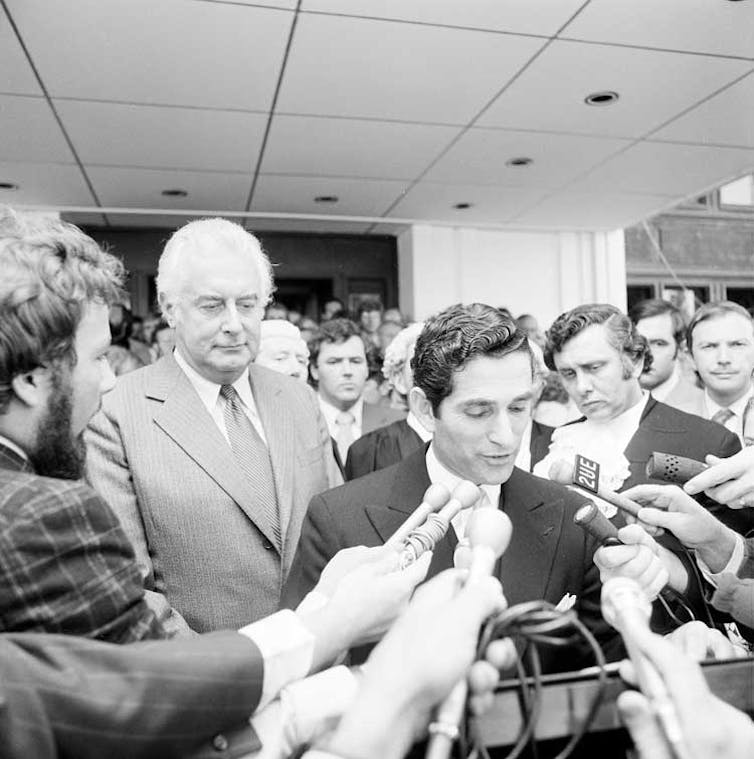
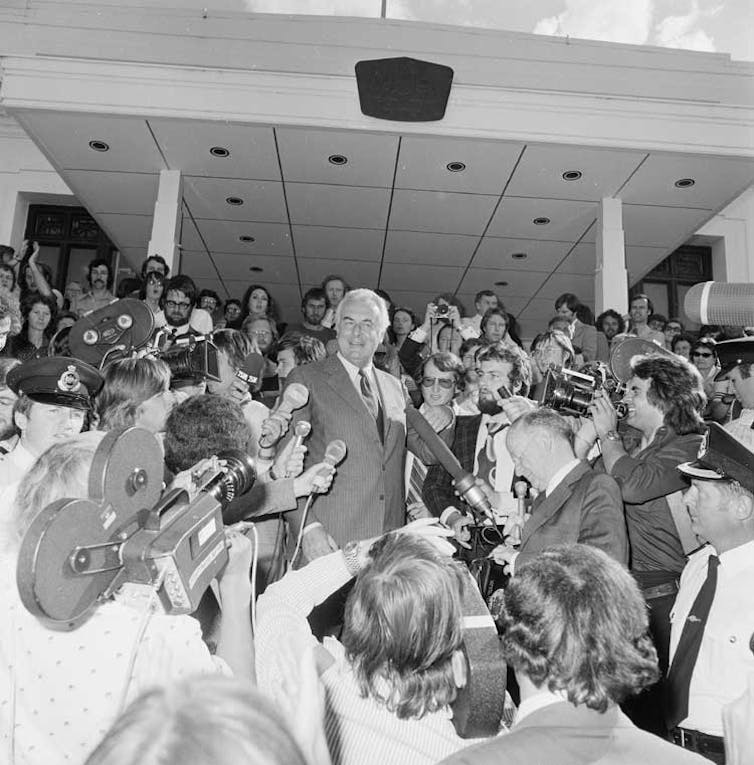
Gough Whitlam outside Parliament House on November 11, 1975. National Archives of Australia
Anne Twomey, University of Sydney
The dismissal of the Whitlam government in 1975 remains as controversial as ever. Its last chapter is to be decided in the High Court today when it hears a case brought by historian Jenny Hocking seeking public access to the letters between the governor-general, Sir John Kerr, and the queen.
Government files on the crisis were released by the National Archives under the 30-year rule and Kerr’s own private notes and reminiscences, which he deposited with the archives, have also been released.
But the letters that Kerr sent to the queen, through her private secretary, about the crisis and any replies, have not been released because they have been treated as “private” correspondence owned by Kerr, and subject to the conditions he placed on them.

Read more: Relics of colonialism: the Whitlam dismissal and the fight over the Palace letters

Conditions of access

The conditions were that they be opened 60 years after Kerr ceased to be governor-general, after “consultation” with the monarch’s private secretary and the official secretary to the governor-general. This was later unilaterally changed, on the queen’s instructions, to 50 years, but with the “approval” (rather than consultation) of the representatives of the monarch and the governor-general. It remains unclear what power the queen had to change and control conditions on access, if the documents belonged to Kerr, as it is claimed, and not the queen.
This change in the deposit conditions is critical, because we now know that the Palace is refusing access to correspondence with any of the queen’s former governors-general, even when the 50 years is up, for a period until at least five years after the death of the queen, and then only if the new monarch agrees.
This means it may never be released, or may be redacted or released only in part.

Public or private correspondence?

One problem with assessing whether the correspondence is public or private in nature is that none of the decision-makers, including the courts, have seen the letters. But experience can tell us a few things about them. First, the queen never personally engages in correspondence with her governors-general. All correspondence goes through her private secretary, and it is he (as they have always been male) who responds to the governor-general.
In times past, when the governor-general was a member of the British aristocracy or upper classes, there was a “personal” element to this correspondence. Letters from Lord Stonehaven, when he was Australia’s governor-general from 1925 to 1930, to the King’s private secretary included discussions about shooting parties, children at Eton and general gossip.
Lord Byng, when governor-general of Canada and facing his own constitutional crisis, addressed the King’s formidable private secretary, Lord Stamfordham, as “My Beloved Stamfy”. There was a mix, at that time, of personal and official roles.
But since the governor-general has been an Australian, the personal aspect has disappeared, and the correspondence became quarterly reports informing the monarch of political, economic, trade, agricultural and social conditions in Australia. The purpose was, and remains, to ensure the monarch is well informed and can therefore more effectively fulfil his or her role with respect to Australia.

Read more: Australian politics explainer: Gough Whitlam's dismissal as prime minister

In addition, there was an obligation on the governor-general to explain any exercise of a power that was done without, or contrary to, ministerial advice, such as refusing a dissolution or dismissing a government. This was strictly enforced.
It is therefore clear, and accepted by the parties, that the correspondence was entered into by Kerr and the queen’s private secretary, as part of their official functions. It was not “personal” in the sense that it concerned family or social matters. It was only personal in the sense that Kerr was writing to the queen personally about how he had fulfilled his functions as her representative. Yet, in doing so, he was fulfilling an official function of the office.

Who owns property in the letters?

The Archives Act makes a distinction between “Commonwealth records”, which are “property of the Commonwealth” and the records belonging to private individuals. So the question is, who owns the “property” in the letters? This raises consideration of who owns the piece of paper the letter is written on, who holds copyright in the letter, whether the sender or recipient owns the letters (and any copies they kept), the capacity in which the letters were written and who currently possesses the letters.
The question for the High Court is which of these factors are relevant or decisive when reading the term “Commonwealth records” in the context of the entire Act, including its purpose of preserving and giving public access to the nation’s historical records.


In the past, some governors-general had taken these letters with them on leaving office. If this indicated they believed they owned the letters, is this enough? Belief would not normally be enough to transfer ownership in a document written by an officer of the Commonwealth in an official capacity.
The Archives Act also recognises that Commonwealth records may end up in private hands, and when private collections are deposited with the archives, any documents within that collection that are “Commonwealth records” are to be treated as such.
This means they must be kept confidential for the requisite period (which has been progressively reduced from 30 years to 20 years) and publicly released if not subject to other exemptions, regardless of any conflicting conditions applied by the depositor.

What is at stake?

If correspondence between the governor-general and the queen is treated as “private” records, rather than Commonwealth records, significant risks arise.
First, this means that whoever inherits the property of the governor-general could sell these records to the highest bidder, at any time, without any secrecy limits or government control. It could be sold to a media organisation that prematurely publicises and sensationalises the letters for profit, or to a private collector who never makes the letters public.
Second, where the documents have been deposited with the archives as a “private” collection, and made subject to conditions that they not be released without the approval of the monarch’s private secretary, they may never be released, or released only in a limited and misleading form.
In both cases, there is a significant risk that Australians will be denied access to, and understanding of, not only one of the greatest political crises in Australia’s history, but how the highest offices in the land actually operate in our system of government. It is hard to believe the Archives Act could be interpreted as operating in a manner that would deny Australians control over and access to such important records of their history.The Conversation
Anne Twomey, Professor of Constitutional Law, University of Sydney
This article is republished from The Conversation under a Creative Commons license. Read the original article.
Sunday, January 26, 2020

Australia Day Honours are a closed book

A bit of interest today in transparency amid controversy over decisions on honours awards by the Australia Day Council .

Are decisions or any other documents held by the Council Secretariat (staff in the Office of the Governor General) subject to FOI?

Nope.

 This from my blog in 2013: 
"The High Court in Kline v Official Secretary to the Governor General [2013] HCA 52) ruled that documents concerning the operation of the Honours system are not within scope of the Freedom of Information Act. The decision ends a long running legal tussle regarding interpretation and application of s 6A which places the Official Secretary's office (among its other support functions, it is the Australian Honours and Awards Secretariat) outside the operation of the act "unless the document relates to matters of an administrative nature."
 More here https://bit.ly/2OeTd5J

Nothing has changed since. 

Calls for FOI reform on a wide range of fronts have got nowhere.

Seven years of coalition government and the most notable contribution to FOI in that time is the eventually unsuccessful attempt in 2014 to abolish the Office of Australian Information Commissioner.

Among the mostly uncontroversial awards was the well deserved Order of Australia OA for Fiona McLeod SC, the Chair of the Accountability Round Table and a former Chair of Transparency International Australia and the Open Government Forum, among many other wonderful accomplishments. Congratulations Fiona.

Have a thoughtful Australia Day.

Sunday, October 23, 2016

Call to arms: Australians should own their own history.

This post four years ago commented on the cringe-worthy news that Governor General's official correspondence with the Queen after the event is packed off to archives at Buckingham Palace and beyond reach of Australian disclosure laws.

Now it emerges that GG Kerr's 1975 correspondence with the Palace that he designated personal is 'private' in the hands of National Archives Australia, not part of official Commonwealth records and subject to normal archives disclosure rules, is embargoed until at least 2027, and the Queen's private secretary holds a final veto over release even after that date.

Shoulders to the wheel folks-If you can contribute to the out of pockets for this legal challenge to quaint ancient world notions of British crown privilege, it's a worthy cause. 

$17k and counting....


Monday, September 30, 2013

High Court hearing scheduled in FOI test for Governor General's Office

The just published latest edition of Anne Summers Reports includes (page 6) my brief summary of the arguments advanced in the successful leave application to the High Court in Kline v Official Secretary to the Governor General, the long running battle over access to information about administration of the Honours system. 

The issue is the scope of the Freedom of information Act and the meaning of the words "relate to matter of an administrative nature" in the context of the powers and functions of  the Governor General in administering the Order of Australia. 

The appeal will be heard in Canberra on 30 October. 

The written submission on behalf of the Appellant by Ron Merkel QC was not available when I wrote the ASR piece about a month ago.

By the by, I understand that the government's costs in fighting this case through its long journey to the steps of the High Court are well north of $130000, not $30000 as mentioned in the article.

Tuesday, August 20, 2013

Statutory interpretation at the nub of High Court FOI challenge on Honours documents.

The meaning of the words 'in relation to matters of an administrative nature" are not only relevant in the Freedom of Information context to documents held by the Office of the Secretary to the Governor General. They appear in other sections of the act concerning courts and tribunals, seem to be what Dr Hawke in his review report is suggesting for the Federal parliamentary departments, and are also in state and territory FOI legislation.

In the course of the successful special leave application to appeal to the High Court in Kline v Official Secretary to the Governor General last week, Ron Merkel QC, for Kline, advanced the proposition that the exemption from the FOI act conferred on the Office of the Governor General by section 6A, except for documents in relation to matters of an administrative nature, reflected competing public interest considerations. 

On the one hand the public interests of openness, accountability and responsibility, as expressed in section 3; on the other a public interest in Section 6A in not intruding on the independence of the exercise of the Governor General's functions and powers and of those assisting her in a particular context or in a particular matter.  

Merkel submitted that documents concerning administrative support processes that go to facilitate the exercise of powers - in this case about the operation of the Australian Honours system - are unrelated to the exercise of a power in a particular matter or context. Such documents relate to matters of an administrative nature, and as such, are subject to the FOI act:
So it is in the particular instance that we say is protected, but the overall objective of sections 5, 6 and 6A is to facilitate the public’s right to know how such bodies are administered other than in a particular instance, and we say that the construction we contend for gives effect to that competing objective. The Full Court’s construction, with respect, effectively renders nugatory access to the FOI Act.
Peter Hanks QC for the respondent agreed section 6A strikes a balance between competing public interests. However, the public interest reflected in the section is "in maintaining the confidentiality of the functions and the councils of the Crown." The general rule of interpretation to approach the construction of a provision in a way that would promote the object of the Act is displaced in this instance:
MR HANKS:We need to construe – we need to understand what is the purpose of this particular provision without reading it in light of the articulated purposes of the Act. The purpose of this provision is to create an immunity from the Act and to do so to serve a particular public interest...
......
FRENCH CJ: Extending to the procedures which they adopt?

MR HANKS: Yes, your Honour, indeed. Now, there are entirely sensible reasons why you would extend it that far; if those procedures which they adopt are designed to ensure the integrity of decisions that are made within the Office of the Governor-General, and their confidentiality is valued in order to avoid manipulation – one can speculate about matters of that sort, but there is a value in maintaining that confidentiality, and extending the confidentiality that far...

Now, in our submission, there is no inherent difficulty in adopting a construction of section 6A that would have that effect. The purpose of section 6A is to provide that only a limited class of documents are to be amenable to requests for access under the Act, and given the nature of the public interest, which we say is reflected in the exclusion, one would expect that the number of documents protected from access would be substantial.
On a related issue concerning the obligation to publish operational information about the Honours system, Hanks submitted the FOI act to the extent s 6A applies, applies to the Office of the Official Secretary - the Council of the Order of Australia and the Governor-General are not prescribed authorities:
Although the Official Secretary is a prescribed authority, the Official Secretary has no involvement in making decisions or recommendations of the kind with which the council and the Governor-General deal. The council has a closely defined membership which does not include the Official Secretary.

So insofar as the reasoning of the Full Court would exclude from access under the Act documents that might be loosely described as operational information if section 8A and section 8 were applicable, it is irrelevant because neither the council nor the Governor-General nor the Official Secretary in relation to the relevant documents is subject to the obligation imposed by section 8 to publish operational information.
The Official Secretary is ex officio Secretary to the Council of the Order of Australia- which may or may not make a difference on a point not central in this case. 

But just why the criteria and related information about the Honours system isn't published is difficult to understand.

The High Court hearing is expected before the end of the year.

Friday, August 16, 2013

FOI coverage of Governor General's Office off to High Court

I hear that the High Court granted leave to appeal today Friday in the Kline case concerning Freedom of Information coverage of documents about the operation of the Australian Honours system. More when the transcript appears- now here.


 A long line of decisions in the case to date have all gone the Governor General's way, the most recent a unanimous decision of the Federal Court that gave broad interpretation to the exemption from the act for documents held by the Office of the Governor General that relate to matters of an administrative nature.

(See :Jane Lee's report in The Age.)


The recently released Hawke Report rejected submissions that the FOI act should be amended to broaden the scope as it applies to the Office of the Governor General, but gave no reasons (p 64), recommended that the parliamentary departments should be subject to the act to the same extent, and while citing the Federal Court decision by name gave no attention to the Court's interpretation of the relevant words "relates to matters of an administrative nature" (p 62) and its narrowing effect.

Tuesday, March 12, 2013

Bid for High Court to look at Governor General's FOI protections

In the March issue of Anne Summers Reports I've written a potted history of Karen Kline's so far unsuccessful attempt to use the Freedom of Information Act to access documents concerning the administration of the Australian Honours awards.
(The Secrets of Australian Honours page 6.)

It is a story familiar to regular readers here except this newsie bit, that Ron Merkel QC has taken up the case after the Full Federal Court decision went against Kline in December.

An application seeking special leave to appeal to the High Court was lodged on 15 February. Special leave is a formidable hurdle. The grounds for appeal, if the case gets that far, include whether the Federal Court erred in holding that any document that relates to a substantive  power or function of the Governor General is not a document that relates to matters of an administrative nature within the meaning of s 6A, and is thereby excluded from coverage of the Act.

A meaty subject worthy of the High Court's attention.

Merkel QC, a highly respected former judge of the Federal Court and one of Australia's leading human rights and civil liberties practitioners who has a string of commendable wins to his credit, appeared for Heather Osland in one of the few, and the most recent, Freedom of Information cases to make it to the High Court. The decision in that one made my 30 years of notable FOI cases list.


I don't know anything of his thinking on the Kline case other than by taking it on he clearly thinks there is something in it.

However in a major speech in December Merkel noted rights trends including three recent high profile cases where the courts have read the Constitution as requiring an "extraordinary limitation on Executive power", with power wound back in these cases "in a way not really thought possible in the 107, 108 years that preceded these decisions." 

Could Merkel's observation then that "we do have the reality of a very substantial Constitutional protection of fundamental rights and freedom in Australia" presage an interesting argument in the High Court regarding a constitutional limitation on exclusions from the Freedom of Information Act?

Anne Summers Reports is a terrific new publication, free and available for subscription here. Anne can only make it work with donations that help with the $300,000 annual cost.

Give it a thought.


Friday, May 04, 2012

AAT pulls the shade on FOI access to Australian Honours guidelines

Administrative Appeals Tribunal Deputy President Hack in Kline and Official Secretary to the Governor General [2012] AATA 247 upheld the decision by Freedom of Information Commissioner Popple that documents sought concerning the operation of the Australian honours system were not subject to the Freedom of Information Act. 

For shades of Sir Humphrey, read on.

Ms Kline had sought access to documents concerning unsuccessful nominations by her of another person for an award in 2007 and 2009, and two other categories of documents: "Working manuals, policy guidelines and criteria related to the administration of awards within The Order of Australia", and "Documents relating to review processes i.e. right of appeal in cases of maladministration."

The issue before the Tribunal was whether the Office was required to deal with the application in the light of  s 6A: the act "does not apply to any request for access to a document of the Official Secretary to the Governor-General unless the document relates to matters of an administrative nature." If the application came within s 6A a separate question not raised in this case would arise concerning any relevant exemptions.

Deputy President Hack rejected what he described (without elaboration) as "sophisticated arguments" on the applicant's behalf, that the words relate to "matters of an administrative nature" should be interpreted broadly. He preferred to use his words, a "simple answer": any documents that relate to any substantive functions of the Governor-General including the award of honours are outside the scope of s 6A. :
 ".. documents generated in connection with the conferral of honours do not ordinarily relate to matters of an administrative nature...While it is possible to conceive of exceptions to this general proposition (correspondence with the supplier of medals and insignia, or with a caterer providing refreshments at the awards ceremony come to mind), the documents in question do not relate to this sort of matter. If the Act was intended to apply to documents generated in connection with a wider view of the Governor-General’s functions, it would have done so using clear words.
(Comment: An even simpler approach might be that "relates to matters of an administrative nature" means "relates to matters of management and administration" but we won't go there.)

In reaching his decision Deputy President Hack drew on the decision of Justice Gray in Bienstein v Family Court of Australia, a Federal Court case involving s 5 and the same FOI limitation as it applies to  documents held by the courts. The Deputy President saw similarities between the functions of the Governor General in making decisions on award nominees, and those of a judge exercising a judicial function. In both cases closed doors were necessary.
22. Choices have to be made between the nominees, and unsuccessful nominees may be upset when they are overlooked. Making those choices is akin to a judicial function that involves the exercise of delicate judgement. The Governor-General has the benefit of the advice of the Council of the Order when making her decisions; the Council is comprised of independent persons who bring a range of experiences and perspectives to bear on their work. That frank advice is essential to the process. While judges give reasons for their opinions, the decision in Bienstein confirms the courts are not expected to expose internal documents that might compromise the integrity of the process in the public mind, if only because they could be misunderstood or muddy the waters. That approach applies equally to documents held by the Official Secretary in relation to the system of honours.
23. The award of honours remains part of the Governor-General’s function, and – like a good deal of the work of the Governor-General – that process has occurred behind closed doors for good reason.
if Deputy President Hack is correct in taking a narrow view of s 6A, this analogy may be correct as far as it goes, putting beyond FOI reach documents held by the Office concerning individuals nominated for awards.

But the reasoning doesn't explain how this "closed doors" imperative is a relevant consideration when it comes to the manuals, guidelines and criteria for awards, and any documents held concerning review procedures. Why such documents need protection because disclosure would impact on "frank advice", "compromise the integrity of the process in the public mind" or "muddy the waters" remains a mystery. Au contraire, disclosure might have a positive rather than a negative impact.

I understand the applicant in this case has preliminary legal advice that there are grounds for appeal.

The broader public policy issue that deserves further consideration is why criteria and guidelines used in determining Australian Honours awards are not published or accessible. 

Arguably documents of this kind are the type that Parliament intended should be made publicly available by every government agency. "Operational information" (defined in s 8A to include rules, guidelines, practices and precedents relating to decisions and recommendations) must be published as part of each agency's Information Publication Scheme- unless exempt.(Government House has no published operational information.)

In line with this decision the Office of Official Secretary won't have to bother dealing with any application for documents for anything to do with the Governor General's substantive functions.

It raises the question how properly to categorise Honours manuals, guidelines and criteria and any similar documents held at Government House if they are not policy or related to matters of an administrative nature? Contributions by sir humphreys welcome.

That said it reminds of the exchange on the BBC's Yes Minister program as Sir Humphrey and the minister darted and weaved to avoid questions before a parliamentary committee- by distinguishing policy and administration.
Betty Oldham: Look, Sir Humphrey, whatever we ask the Minister, he says is an administrative question for you, and whatever we ask you, you say is a policy question for the Minister. How do you suggest we find out what is going on?
Sir Humphrey Appleby: Yes, yes, yes, I do see that there is a real dilemma here. In that, while it has been government policy to regard policy as a responsibility of Ministers and administration as a responsibility of Officials, the questions of administrative policy can cause confusion between the policy of administration and the administration of policy, especially when responsibility for the administration of the policy of administration conflicts, or overlaps with, responsibility for the policy of the administration of policy. 

Monday, February 20, 2012

Government House grins and bears testing FOI applications

A rare visit to the Governor General's website to locate the Bonsey report led me to this response a year ago, posted in the Disclosure Log sometime after May, to two FOI requests from Samantha Maiden (pdf) of The Australian. What is of interest is the broad ranging nature of the applications, and that they appear to have been processed without demur, free of charge, and "in the spirit of goodwill and transparency where no documents exist," some information provided above and beyond what is required by the act. (How else would we know that the average price of a bottle of wine served at Yarralumla is $11.64? Pity they didn't volunteer where the rest of us might find a more than passable drop at this, or an even cheaper price).

I have no idea whether Maiden as a journalist received special treatment or if your average FOI punter would get this sort of response to applications for documents for the last three years concerning 16 different topics, with sub-headings in most cases to spell out the detail. I would have advised against lodging all encompassing applications of this kind-shows what I know! Maiden clearly is not one of those smarties said to be artificially breaking requests into small parcels in order to gain multiple shots at five free hours of decision making time that some agencies are concerned about.

Some of the information sought was already in the public domain, or wasn't held, because for example the Governor General pays for her own clothes, hair and make up, and there are no separate records of dry-cleaning bills. Or was not matter of an administrative nature, and outside the scope of the act as it applies to the office, such as correspondence with Julia Gillard, Kevin Rudd and the Queen.

Government House only raised the issue of substantial and unreasonable resources when declining to produce original invoices but nevertheless extracted global information from records and provided it. Others might have been tempted to use these applications to test the limits of the diversion of resources provision.

The notice of determination may have FOI purists tut tutting over technical aspects of the response, but as the AAT readies for argument about the scope of s 6A and what constitutes a document that relates to matters of an administrative nature, Mr Fraser who signed off and others at Government House who were involved exhibited persistence, endurance, and patience akin to that of a saint quentin. And forbearance afterwards when a fair bit of the information gathered and released didn't make it into what appears to be the only story Maiden wrote subsequently. Which focused on travel, flowers - and the wine bill.