Search This Blog

Showing posts with label Accountability. Show all posts

Monday, December 07, 2020

Reveal: Politicians easily dodge accountability for their mistakes-because they can!

Damian Shaw/AAP
Chris Aulich, University of Canberra

In recent days, the issue of government accountability was brought into sharp focus — again — when NSW Premier Gladys Berejiklian admitted that community grants awarded primarily to councils in Coalition seats ahead of the 2019 state election was pork barrelling.

In defence, she said the practice of pork barrelling was “rightly or wrongly” normal and wasn’t illegal, and that governments of all colours engage in election spending in order “to curry favour” with the electorate.

When the premier of NSW uses as a standard of integrity that pork barrelling is “not against the law”, she shows contempt for democratic conventions and a U-turn from the views she expressed in February 2019 when introducing measures to strengthen integrity in government.

These measures included a revised code of conduct for ministers and a stern reminder to politicians that they “always remain accountable to the community”.

Ministers were once held to a higher standard

In the 1960s, the eminent scholar Roger Wettenhall argued ministers were accountable for all that occurred within their departments.

This was a recognition that even if ministerial action was not directly responsible for errors, ministers were nonetheless accountable for them. In the most serious cases, there was an expectation that ministers should resign, though in reality, few ever did.


Read more: As the government drags its heels, a better model for a federal integrity commission has emerged


Ministers are not just accountable for significant errors made within their departments, but also for behaviours deemed contrary to their ministerial code of conduct. Again, conventions hold that ministers should resign if their actions are deemed dishonest, were intended to mislead parliament or the public, or brought the government into disrepute.

Many ministers have resigned over improprieties in the past. For instance, Immigration Minister Mick Young stood aside over the “Paddington Bear” issue, Jim Cairns resigned over improperly seeking overseas loans, Jamie Briggs stepped down over his “personal behaviour” and Michael MacKellar resigned over importing a colour television.
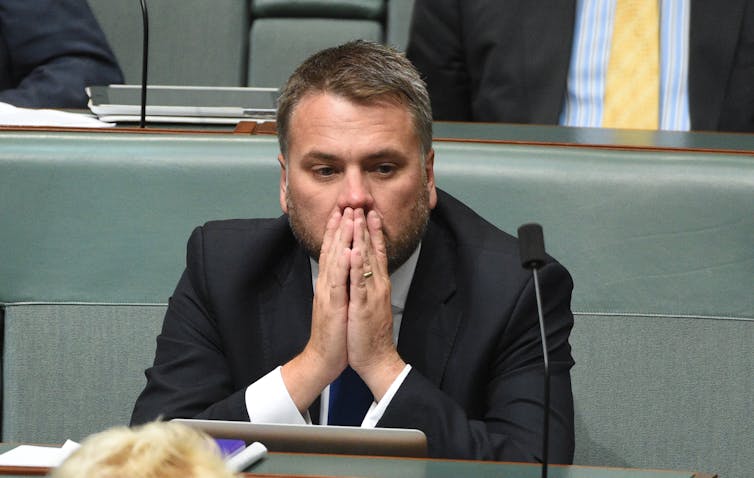
Briggs resigned as a minister in the Turnbull government.
Briggs resigned as a minister in the Turnbull government over an incident in a Hong Kong bar involving a female public servant. MICK TSIKAS/AAP

How ministers today have dealt with scandal

But fast forward to today, and neither Richard Colbeck nor Stuart Robert have resigned over major blunders within their ministries related to aged care and the “robodebt” scandal, respectively.

This begs the question why Prime Minister Scott Morrison did not deem it sufficiently important to exact accountability from his ministers for their major mistakes, especially when these two cases cost more than a billion dollars of public funds.

It also remains unclear why minister Angus Taylor, who sent a letter to the lord mayor of Sydney making false accusations about the Sydney City Council’s travel expenses, was not asked to resign.
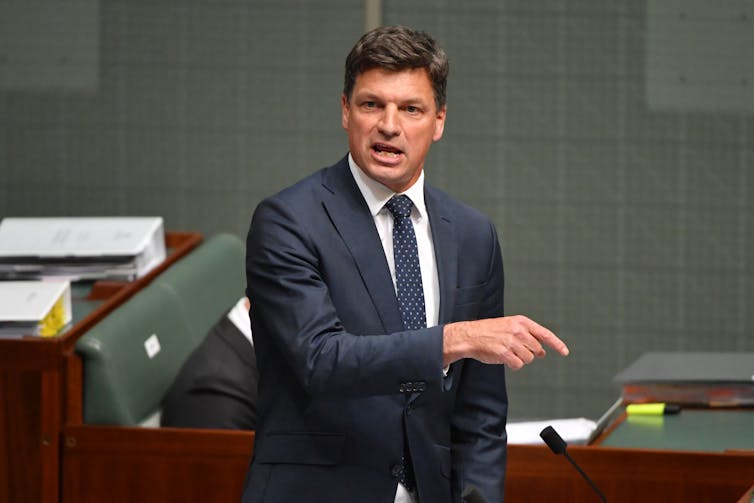
Taylor was forced to apologise for the letter.
Taylor was forced to apologise after the figures in his letter were proved incorrect. He says he now considers the matter ‘finalised’. MICK TSIKAS/AAP

Similarly, the personal conduct of ministers Alan Tudge and Christian Porter has come under scrutiny thanks to an ABC Four Corners investigation, but has been dismissed by Morrison on the basis their alleged actions occurred during the watch of the previous prime minister.

And on numerous occasions, the travel allowances for ministers and MPs have been challenged, without serious repercussions. The current federal ministerial code of conduct spells out clearly that such indiscretions are not acceptable.


Read more: What's in the 'public interest'? Why the ABC is right to cover allegations of inappropriate ministerial conduct


This brings us back to the issue of pork barrelling. At the federal level, minister Bridget McKenzie did resign this year over the “sports rorts” affair. The code of conduct provides that ministers allocate the funds available to them in “the public interest”. McKenzie’s view that the public interest was the same as her party’s interest was unacceptable.

This scandal has parallels with an earlier “sports rorts affair” that cost Labor minister Ros Kelly her position in 1994, as well as with the current NSW local government grants scheme with its shredded papers.

Rather than accept their accountability like McKenzie and Kelly, Berejiklian is maintaining that pork barrelling is common practice — an opinion that might well be contested by parliament and the community.
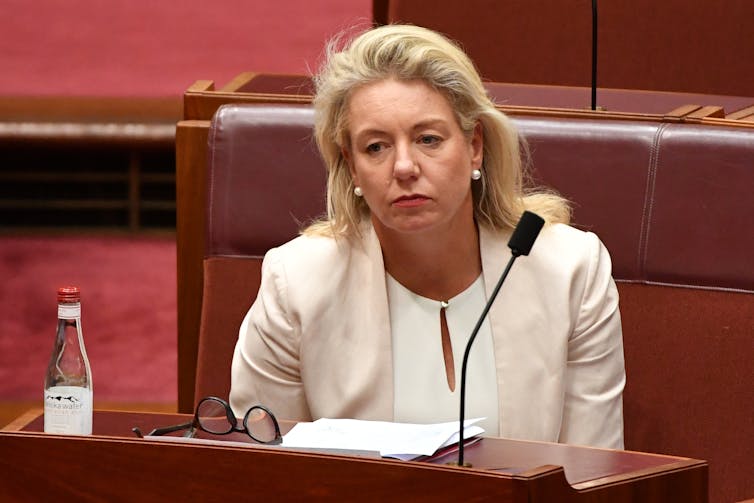
McKenzie resigned from Morrison’s ministry.
McKenzie resigned from Morrison’s ministry in February over her role in the sports rorts affair. MICK TSIKAS/AAP

Have politicians been emboldened by their COVID successes?

Why, then, are so many current politicians willing to dodge taking accountability for their actions? The easy answer is because they can.

After all, the government conventions around accountability have no legal force. They have merely been “honoured” by politicians as part of our democratic culture – as sociologist Edgar Schein suggests, it is “the way we do things around here”.


Read more: The long history of political corruption in NSW — and the downfall of MPs, ministers and premiers


It seems current politicians are re-setting this democratic culture and the conventions that go along with it. Modern politicians are now very savvy in managing the press, and deft at reframing issues to their advantage.

Berejiklian gave a master class in this when she was confronted with accusations of failing to disclose an intimate relationship with disgraced former MP Daryl Maguire.

She reframed the issue as a personal one, in which she had been swept along by a romantic attachment. She argues, probably correctly, that she did nothing that was illegal. However, her actions were highly questionable from an ethical point of view.
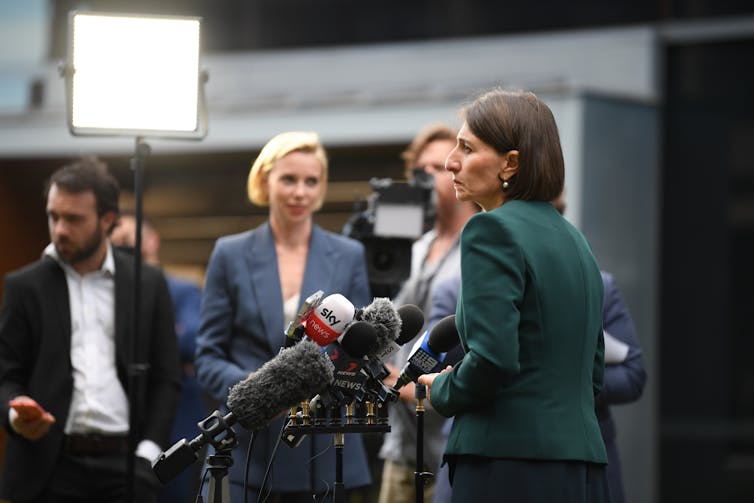
Berejiklian has been under intense media scrutiny.
Berejiklian has been under intense scrutiny since revealing her relationship with Maguire in October. DEAN LEWINS/AAP

Perhaps our current federal and NSW leaders have been emboldened by their successes in responding to the pandemic and are counting on this to defuse criticisms of their actions. They likely believe that issues of accountability — at least in the public mind — might pale in relation to the “big” issues of bushfires and COVID-19.

As such, ignoring accountability is seen as merely a small peccadillo.

Independents may be the key

In the broader context, voters have shown they are more willing to elect local independents, such as Helen Haines, Rebekha Sharkie and Zali Steggall at the federal level and Roy Butler, Joe McGirr and Helen Dalton in NSW, who are not seen to be in the mould of other politicians.

There is clearly a move towards candidates who place a very high value on conventional values, such as representation and integrity. And it is these members who may act as circuit breakers to stop the further corrosion of democratic conventions in our governments.

Simon Longstaff, executive director of The Ethics Centre, summed this up well when he noted

we want politicians who see engagement in public life as a vocation and not just a game. We want politicians who will speak the truth - even when it harms them to do so. We want politicians who respect us as citizens and not just as voters.

If the major parties continue to ignore accountability, perhaps the election of independents and minor parties will provide the stimulus for truth to power.The Conversation

Chris Aulich, Adjunct Professor at the University of Canberra, University of Canberra

This article is republished from The Conversation under a Creative Commons license. Read the original article.

Friday, January 13, 2017

Has the PM answered the call: An integrity agenda for 2017?

The Prime Minister in conjunction with the resignation of Health minister Sussan Ley has announced a commitment to further changes to the parliamentary entitlements system.

The changes go beyond the recommendations in the Conde report already accepted in principle and according to an earlier announcement to be acted upon in the first half of 2017.

The PM:
"Australians are entitled to expect that politicians spend taxpayers' money carefully, ensuring at all times that their work expenditure represents an efficient, effective and ethical use of public resources," he said. "We should be, as politicians, backbenchers and ministers, we should be as careful and as accountable with taxpayers' money as we possibly can be." Mr Turnbull also announced that a new body overseeing parliamentary expenses would be created.
"The Government believes that the work expenses of parliamentarians, including ministers, should be administered and overseen by an independent agency," he said.
"An independent parliamentary expenses authority will be a compliance, reporting and transparency body. It will monitor and adjudicate all claims by MPs, senators and ministers, ensuring that taxpayers' funds are spent appropriately and in compliance with the rules."

Describing transparency as key, Mr Turnbull said the new system would allow the public to view expenses in "as close to real time" as possible. "The system that manages entitlements will be modernised to allow monthly disclosure of parliamentarians' expenses in an accessible — that is to say, searchable — format," he said."[Currently] Most of the forms are filled in by the politicians by hand. It is all paper-based. The reports that you do find on the Department of Finance website are big PDF files. They are, you know, months out-of-date when they are posted."
Welcome news.

As per usual the devil is in the detail, yet to come.

A few thoughts:
  • Apart from Conde there are recommendations not acted upon in a number of auditor general reports stretching back to 2001-2002 and from the Belcher committee report in 2010. Hopefully they haven't been lost in time.
  • No mention so far of a Code of Conduct for Parliamentarians. Maybe the legislation the PM has in mind will go further than a code when it comes to responsibilities. Great. However the Coalition in 2010 wouldn't have a bar of it when John Faulkner tried to persuade Parliament to introduce a code.
  • "Parliamentarians entitlements"paid by Finance are only part of the picture. Some payments are made to or on behalf of members and senators by the Parliamentary departments, including support for and the cost of hospitality incurred by the Presiding officers. These payments currently are not  published. Parliament in 2013 excluded the parliamentary departments from the Freedom of Information Act.
  • Each department pays for the costs involved in supporting its minister, including official hospitality and who knows what else. These expenditures currently are not published.
  • The PM is right to state parliamentarians must be "as accountable with taxpayers' money as we possibly can be."Transparency and accountability should also extend to searchable information about declarations of interest (PM- they're in PDF files), contact with lobbyists ( PM-not published), and political donations (PM-can be published up to 18 months after the event.)
  • A parliamentary expenses authority should help keep things within reasonable limits. However a government serious about integrity would accept that a Federal anti-corruption body is also much needed.
As Peter Hartcher in making similar points in Fairfax Media recently said
"The cause of cleaning up Canberra is an inevitable one. The only question is who will best do it, and whether the energy will be channelled constructively to fix our democracy or destructively to make it weaker."
Trust and confidence 

Before the 2016 election campaign got underway the Roy Morgan Annual Survey revealed Federal Politicians are rated highly on Ethics and Honesty by 17% (up 4% in a year), putting them 23 of 30 professions included in the survey.

As scored on ABC Vote Watch the Prime Minister finished the election campaign in July with a personal trust rating of 4.5 out of 10, Bill Shorten 3.7 and Greens leader Di Natale 3.9.

According to the ANU Post Election 2016 Survey 74% agree "People in government look after themselves." Only 26% say "People in government can be trusted."

The PM knows all this. As he said in July last year:
"There is no doubt that there is a level of disillusionment with politics, with government, and with the major parties. Our own included. We note that. We respect it," Turnbull said. Now, we need to listen very carefully to the concerns of the Australian people expressed through this election. We need to look at how we will address those concerns that's what the Deputy Prime Minister and I have been discussing today. There are lessons to be learned from this election."
On the other hand we've heard good intentions before.

Tony Abbott before the 2013 election as reported in the Sydney Morning Herald:
Abbott's first priority if he wins the election will be to seek to rebuild Australians' confidence in government and restore civility to the national political discourse after three bruising years of minority government.
''The greatest deficit in our country at the moment is the trust deficit. Sure we have got a very serious budget deficit, but the trust deficit is even more serious. I would hope that, should we win the election, I would be able to so conduct myself and my team would be able to so conduct themselves that by the end of the first term people would have once more concluded that Australian government was competent and trustworthy
 We live in hope for 2017.

Tuesday, April 07, 2015

NSW Premier Baird needs no hand with intergrity

Premier Baird had a good win in the NSW election on 28 March and has since announced a new ministry "A Fresh team for Rebuilding NSW."  The team consists of 22 ministers who between them carry 45 titles (Minister Goward has five) plus 16 parliamentary secretaries. 

Regrettably no one is singled out for special responsibility for integrity and related matters.

The Premier has previously stepped up on political donations and lobbying but there's still much to be done  and a co-ordinated approach would be a sign of serious intent. Maybe Catherine Cusack who has no specifics in her job title of Parliamentary Secretary to the Premier may take this on board?

During the campaign Premier Baird declined to sign the Politicians' Pledge promoted by the St James Ethics Center. 

So did all but three of his Liberal/National Party colleagues. Two of the three feature in the front bench lineup: Mark Speakman Minister for the Environment, Minister for Heritage, and Assistant Minister for Planning and John O'Dea Parliamentary Secretary for Major Events and Tourism.

Prior to the election the Liberal Party did respond to questions from the Accountability Roundtable confirming no plans to diminish the powers of the ICAC; support for further reform of political donations law; commitment to open data and open government; acknowledging "public office is a privilege and that the exercise of power as a public office holder should and will always be made in the public interest"; and vowing "to clean up politics in NSW."

All to the good. 

But in a state with more than its share of dodgy business in recent years from those in both major parties NSW should follow the lead of the two other new state governments where the premier assigned specific responsibilty for integrity and transparency matters.

In Victoria Gavin Jennings is Special Minister of State, operating within the Premier's portfolio  to "oversee government transparency, integrity, accountability and public sector administration and reform." In Queensland  the Premier is supported by Assistant Minister Stirling Hinchcliffe who will "directly assist me on integrity and accountability issues."

Good luck to us all.

Monday, March 16, 2015

Premier Baird gives Politicians' Pledge the brush: just trust us, please

In the second (and last) leaders debate in the NSW election campaign on Friday Chris Uhlmann asked only one question about trust and left it when both said a few things about political donation reform. 

Maybe Uhlmann hadn't heard of the Politicians' Pledge or didn't think commitment to the pledge was worth pursuing, let alone the smorgasbord of other integrity, transparency and accountability issues that deserve an airing in the interests of good, honest, clean government. 

Whatever, it was poor judgment in an election campaign where the electorate needs no reminder of the record of both major parties, and on trust the Premier is rated 5.5/10, the Opposition leader 4.3/10. (ABC Vote Compass)

On Saturday The Sydney Morning Herald reported Premier Baird declined to sign the pledge. 

Instead, the Premier said he and his Liberal team "will always act in your interests, and will do so in an ethical and democratic manner." (So too The Shooters and Fishers Party saying its MPs took an oath of office and their "honesty and integrity is beyond reproach.)

The general commitment to ethical and democratic values didn't deliver those goods from Liberal or Labor in the recent past. It's why candidates should be willing to provide  assurance by signing on the dotted line to a list of basic democratic values.

Opposition leader Foley told the Herald he would sign as would all Labor candidates. So far they aren't on the published list. Two of Premier Baird's Liberal team both sitting members have broken ranks and signed on as well as a growing number of others.

It's puzzling what Premier Baird finds difficult in the pledge.

Campbell Newman in Queensland similarly found it difficult to commit to the Fitzgerald principles until saying no proved indefensible during a leaders' debate there.

With less than two weeks to the election in NSW will Premier Baird come to the same realisation?

The Politicians' Pledge:

Tuesday, February 17, 2015

Good governments recognise integrity and accountability are part of the package

Evidence that those who win public office have sniffed the breeze: the new governments in Victoria and Queensland have each appointed a special minister of state responsible for integrity and accountability issues. 

Hopefully a pointer for those running for office next in NSW on 28 March.

And for a federal government now almost half way through its term whose leader declared a week ago "good government starts today." 

The government has virtually nothing positive to show on the integrity and accountability front after 17 months. 

And its bill to abolish the independent statutory office established to oversight the public right to access government information remains on the bills list while the office operates with "reduced resources in anticipation of closure."

In a poll four months ago 46.5 per cent believed the Federal government to be untrustworthy, a lower level of trust than enjoyed by state and local counterparts.

 It's likely to have gone to new depths since.

Good government includes recognition that integrity and accountability are part of the package.

Followed by action to match on political donations and lobbying reform; transparency, supporting open government instead of closing down the information commissioner; an anti corruption plan to include an anti corruption body; upgrading whistleblower protection to best practice standard; a code of ethics for parliamentarians; and signing on to the Open Government Partnership.

All the while going beyond the public servants in the parliamentary triangle to engage with the broader community on these and related issues.

Thursday, February 05, 2015

For the pollies who listen, time for the Minister for Integrity.

The whiff of interest in such things is getting stronger. Except on the Federal scene where we have a trust deficit disaster.

Victoria put integrity up in lights with the appointment of a Special Minister of State responsible for a wide range of integrity measures. Gavin Jennings ranks third in the ministerial line up, not as an add on at the bottom of the list.

Integrity and accountability are certain to feature in the forthcoming NSW campaign with the major parties both desperate to ditch the baggage opened up by the Independent Commission Against Corruption.

Labor made much of these issues in the incredible Queensland campaign. 

Commitments to improve integrity measures there proved crucial in winning Independent Peter Wellington's support for a Palaszczuk government, announced today.

In an exchange of letters the leader of the opposition, within two seats of a majority, reaffirmed the commitment to the Fitzgerald Principles; undertook to reintroduce a $1000 disclosure threshold for political donations and to work with the Electoral Commission to develop a real time online disclosure of donations; ensure the anti corruption watchdog, to be headed by a new independent chair, holds a public inquiry into the links if any between donations to political parties and the awarding of tenders, contracts and approvals; will make all public service appointments on merit; and explore a possible Bill of Rights In Queensland.

But not a word about such things so far in Prime Minister Abbott's look into the future with the emphasis on a 'safe and secure Australia', strong economy, jobs, families, and budget repair (without pain). 

This despite the pre election acknowledgement by Mr Abbott that the trust deficit was bigger than the budget deficit, and that commentators including Lenore Taylor now call it a trust deficit disaster.

The Abbott government should sniff the breeze: political donations, lobbying, transparency, supporting open government instead of closing down the information commissioner, an anti corruption plan to include an anti corruption body, upgrading whistleblower protection to best practice standard, a code of ethics for parliamentarians, signing on to the Open Government Partnership, engaging with the broader community on these and related issues. 

Best led and sheperded by a minister for integrity in name or in practice.

Federal Labor, about to see Senator for Integrity John Faulkner walk out the door any day now, shouldn't wait a moment to follow the Victorian brothers and sisters by tagging a top performer on the opposition front bench with these responsibilities. 

Friday, November 21, 2014

Warning that doing government business through personal emails could amount to misconduct, or worse.

The South Australian Independent Commissioner Against Corruption (Annual Report pdf P57) is concerned that some public officers, mainly ministerial staffers, use personal rather than government email accounts to conduct official business and sounds a warning:
"It has been suggested that the reason for doing so is to avoid the requirement to disclose those emails where an application is made under the Freedom of Information Act 1991(‘FOI Act’). If it is the case that public officers are engaging in this kind of conduct to avoid the consequences of the FOI Act, that conduct should cease immediately. It is a matter of concern that public officers would seek to circumvent a legislative scheme designed to enhance transparency in government decision making. Such conduct might, at the least, amount to misconduct in public administration and be the subject of investigation and potential disciplinary action. I am told that the FOI Act is often abused. If that is so that is a reason to address that Act. It is not a reason to frustrate the FOI Act. While it remains the law the spirit of the Act should be observed by all public officers. Presumably those emails are not maintained in accordance with the State Records Act 1997 (‘SR Act’) (where that Act applies). The conduct therefore might also amount to an offence against section 17 of the SR Act. An offence against that section by a public officer while acting in his or her capacity as a public officer would amount to corruption in public administration under the ICAC Act."
Just a South Australian issue? 

I haven't seen it raised by the various watchdogs in other Australian jurisdictions, but it would be naive to think it doesn't or couldn't happen elsewhere.

And just ministerial staffers?

In an article in July this year based on documents released under FOI about an advertising campaign by the Rudd government to deter boat arrivals, Tom  Swann uncovered references to an email described as from “the Minister’s Gmail”:
The first email was sent at 8pm on Thursday, July 18, by the department’s head of communications, Sandi Logan. It contained the guidelines’ criteria for exempting a campaign from normal scrutiny, with the words “extreme urgency” underlined. Close to midnight someone in the prime minister’s office sent a media plan – “canvassed and locked-in” – to Burke’s media advisers and senior immigration bureaucrats. The sender’s name is redacted, but the email is described elsewhere as coming from “the Minister’s Gmail”. The email ordered “Full-page ads in all metro tabloids the day after the announcement and the next 3 days”, “Ads in all major ethnic papers”, “radio spots” and “social media”, with a budget of $30 million. It also provides the campaign slogan.


"Personal emails" cropped up in the UK in 2011 as an access issue prompting the Information Commissioner there to issue guidance that emails of this kind could, depending on content, come within the terms of the FOI act there. On that score in most jurisdictions here, the test would be whether the email is held by the agency or in the possession of an officer carrying out duties. 


Tuesday, November 18, 2014

The public trust principle and delivering on the G20 'best practice' commitment

Tim Smith QC, Accountability Roundtable, yesterday on Fairfax The Zone:
I think it is clear that open and accountable government will produce better government than secret government. Secret government - government that thrives on secrecy - becomes hostage to the more powerful and assertive interests in the community, and tends not to have the benefit of the views of others in the community who have something relevant and important to say.

Turning to the public trust principle: it is one that I was not aware of until 2009, and I have found that I am in good company. Very few people are aware of it. Now, obviously when you say that you have entrusted someone with power over your life, you expect that person to exercise the power in your interests and not their own interests.

That would be the expectation on the person to whom you have conferred the power. In terms of public office, we voters entrust those we give our vote to with enormous powers over our lives. And simply as an ethical principle, it seems to be unarguable that in that situation the person entrusted with the power by us should give primary emphasis always to what is in the public interest, and if they find their personal interest in conflict, they must give priority to the public interest.

But I now know, after further research and consideration and discussion that this is not simply an ethical principle. It is part of the common law of Australia.

May I quote the former Chief Justice of the High Court from his speech made before presenting the ART Parliamentary Integrity Awards last year

“It has long been an established legal principle that a member of Parliament holds “a fiduciary relation towards the public” and “undertakes and has imposed upon him a public duty and a public trust”. The duties of a public trustee are not identical with the duties of a private trustee but there is an analogous limitation imposed on the conduct of the trustee in both categories. The limitation demands that all decisions and exercises of power be taken in the interests of the beneficiaries and that duty cannot be subordinated to, or qualified by the interests of the trustee”
And on the question how might Australia best proceed with the G20 commitment 
to international best practice,Tim flags the Open Government Partnership as one of the pathways:
 
To honour our commitment to lead by example in implementing international best practice for public sector transparency and integrity, Australia will need to attend quickly to two other major international commitments as signatories to the UNCAC and as an applicant to join the Open Government Partnership (OGP). The OGP was established in 2011 by 8 countries including the USA, UK and Indonesia. Under the UNCAC, Australia is yet to complete its required National Anti-corruption Plan (NAP) and, under the OGP, its first Direct Action Plan. Both the UNCAC and OGP also spell out, as international best practice, that the plans required be developed in consultation with civil society. 
So there is cause to hope that our G20 commitment indicates that these matters will now be addressed. After all, we would otherwise fail to honour our commitment to lead by example. In addition we would be ignoring, to our own cost, what the over 60 members of the OGP understand and accept, namely, that strengthening open and accountable government will help domestic and international economic growth, one of Australia's major objectives. The public interest appears to point in one direction.

Monday, November 17, 2014

G20 countries to lead on international best practices for public sector transparency and integrity

From the 2015-16 G20 Anti Corruption Plan (pdf), an "agreed document" that supports the Communique issued at conclusion of the Leaders' Summit in Brisbane yesterday, this from the section Public sector transparency and integrity:
"G20 countries commit to leading by example in ensuring our government agencies, policies, and officials implement international best practices for public sector transparency and integrity.  The (Anti Corruption Working Group) has identified public procurement, open data, whistleblower protections, immunities for public officials, fiscal and budget transparency, and standards for public officials as issues which merit particular attention."
We look forward to engaging with the Government on this challenge. For starters, abolishing the Office of Australian Information Commissioner and its important function as independent monitor, advocate and 'champion' of open government, as proposed in government legislation currently before the Senate, is not international best practice.

Timely also that Tim Smith QC from the Accountability Roundtable is in The Zone
at Fairfax Media today explaining
those in public office hold positions of public trust and should therefore place the public interest above all other considerations. From this flow such tenets of democracy and public policy as accountability and transparency. And under our legal system, the principle has expanded beyond the realm of ethics to guide and become enshrined in judge-made law, the common law.
 Tim is answering questions here .

Tuesday, July 08, 2014

What's the problem: why not close to real time disclosure for accountability purposes?

With all the talk and welcome enthusiasm in open government circles concerning public release of government data sets, governments, including the legislative branches are yet to fully embrace timely, searchable publication on the internet of information that goes to accountability.

Some quick examples off the top of my head. I'm sure deeper digging would see the list multiply many times over.

Voters go to elections without knowing who has funded campaigns, and at other times have no idea for close to two years who may have kicked the can. Federal election disclosure returns are made available for public inspection 24 weeks after polling day on this website. Annual disclosure returns are similarly made available for public inspection from the first working day in February, ie seven months since the end of the reporting period, and 19 months since any donation made at the commencement of the period. With some variations its the same in the states. Why not continuous on line and easily searchable disclosure close to real time?

NSW joined Queensland and the ACT from 1 July in the publication of ministerial diaries.Its far from universal practice however. Queensland diaries are published monthly at the end of the following month. NSW returns are required quarterly with ministers given a month at the end of the quarter to complete the paperwork. Publication on the Premier's Department website will occur up to four months after the contact. Why not continuous disclosure, searchable across all ministers, close to real time?

(The original post also referred to the failure just about everywhere to provide comprehensive single site searchable information close to real time about parliamentarians entitlements, and up to date searchable information contained in the register of interests. In removing a gremlin I've lost the text!!)

Monday, June 23, 2014

Civil society puts it to the G20: open, transparent government part of the growth equation.

The C20 Global Summit has called on the G20 to tackle endemic corruption, confront the challenges of climate change and urgently address the social and economic time bomb represented by the world’s unemployed youth.


Governance was one of the four key policy issues preoccupying the Summit. 

The decline in trust and the associated issue of lack of transparency and accountability were constant refrains in various sessions including open government, anti-corruption and tax transparency.

Chair of the C20 Steering Committee Tim Costello said
“Good governance includes transparency and accountability to citizens.” 

Relevant policy 'asks' from the Summit aimed at tackling corruption and addressing the  transparency issue include the development of a new focused and measurable G20 Anti-Corruption Plan, and public registries required to disclose accurate beneficial ownership information – in open data format – of companies, trusts and other legal structures, to tackle tax avoidance, tax evasion, corruption, money laundering and terrorist financing.

The Summit Communique was handed to the Prime Minister, the chair of this year's G20 leaders, yesterday.

In the lead up to the Summit an economic analysis on the potential of open data to support the G20’s 2% growth target was released in Canberra by Martin Tisne of the Omidyar Network. The analysis Open for Business was undertaken by Lateral Economics and illustrates how 
"an open data agenda can make a significant contribution to economic growth and productivity. Combining all G20 economies, output could increase by USD 13 trillion cumulatively over the next five years. Implementation of open data policies would thus boost cumulative G20 GDP by around 1.1 percentage points (almost 55%) of the G20’s 2% growth target over five years."
The C20 Communique calls for G20 members to "release data and statistics used to inform the G20 working groups as open data where legally possible and include open data requirements within G20 policy recommendations." 

The Open for Business Report calls on G20 governments to sign up to the Open Data Charter, as the G8 urged a year ago.

Minister for Communications Malcolm Turnbull noted earlier in the year:
Unfortunately, in Australia, the private sectors interest in leveraging public data has been limited simply because of the lack of data that has been made publicly available. We are committed to working with agencies to ensure the publication of data becomes a routine government function. And importantly, if we are to catch up with  the United States, which has published more than 200,000 data sets, we must ensure that data is not only published regularly but in a machine readable form. We are committed to turning around our slow start to empower the private sector to capitalise on the disruptive potential of information, of data...
The current Australian Government's Principles on open public sector information state that open access should be our default position. And this approach is reflected in the United States too where President Barack Obama, on his first full day in office, who issued a presidential memorandum that,"in the face of doubt, openness prevails [when it comes to the release of agency data]."
And, as recommended by the Government 2.0 Taskforce, the information must be truly open. So unless there are good reasons, to the contrary, government information should be:

  • free
  • easily discoverable
  • based on open standards and, of course, machine-readable
  • properly documented and therefore understandable, and
  • licensed to be freely reusable and transformable."
So terrific that government might do more to make data holdings publicly available, giving effect to Parliament's intention in the (2010) objects section of the Freedom of Information Act "to increase recognition that information held by the Government is to be managed for public purposes, and is a national resource." 

However opening up the data side of the shop with more discretionary disclosure while leaving unattended the broader issue of transparency and accountability would lead to one door open and the other half (or more) shut.

Let's open both doors wider by commiting to the Open Government Declaration on the way to membership of the Open Government Partnership. 

Thereafter fully engage in a meaningful partnership with civil society to develop a national action plan that addresses open data, and improved transparency for accountability, public participation, anti-corruption and a myriad other purposes. 

There's a dollar sign as well somewhere for improving trust, confidence, and ultimately government's capacity to make and stick with hard decisions that advance the public interest.
uphold the principles
uphold the principlesthe Open Government Partnership,

“Key policy asks to come out of the Summit aimed at tackling corruption and recognising the need for transparency, included the development of a new focused and measurable G20 Anti-Corruption Plan.
“Also needed are public registries required to disclose accurate beneficial ownership information – in open data format – of companies, trusts and other legal structures, to tackle tax avoidance, tax evasion, corruption, money laundering and terrorist financing.
“Good governance includes transparency and accountability to citizens,” Costello said.
- See more at: http://www.probonoaustralia.com.au/news/2014/06/g20-thrown-challenge-inequality-and-sustainable-growth-c20-summit#sthash.oJ9CJFNq.dpuf
“Key policy asks to come out of the Summit aimed at tackling corruption and recognising the need for transparency, included the development of a new focused and measurable G20 Anti-Corruption Plan.
“Also needed are public registries required to disclose accurate beneficial ownership information – in open data format – of companies, trusts and other legal structures, to tackle tax avoidance, tax evasion, corruption, money laundering and terrorist financing.
“Good governance includes transparency and accountability to citizens,” Costello said.
- See more at: http://www.probonoaustralia.com.au/news/2014/06/g20-thrown-challenge-inequality-and-sustainable-growth-c20-summit#sthash.oJ9CJFNq.dpuf

Tuesday, May 20, 2014

The Trust Thing

A month before the furore over the Budget and broken promises,12% of Australians rated Federal (and state) parliamentarians highly for ethics and honesty, according to the most recent annual Roy Morgan poll of attitudes towards 30 professions. Nurses (91%), doctors and pharmacists (86%) were way out in the lead.

The pollies were down two (state parliamentarians three) points in a year, and a whopping 11 points since 2008, only matched by Ministers of Religion who dropped 13% in the same period.The ministers' current 37% score however is three times that of the politicians who tied with union leaders and in a field of 30 came in ahead of just three, real estate, advertising and car sales types.

With confidence in politicians to do what is right at such a low level, you would have to think someone in government is thinking about how to reverse the trend. It's not evident anywhere I look. 

Tony Abbott seemed onto this, citing the trust deficit as the biggest of those facing government from the time the election was called in August 2013. But it hasn't proved his strong suit then or since.

The Coalition for example had nothing to say during the campaign about how it planned to restore trust other than the mantra 'stop the boats' etc. The Budget, and denial that any promises have been broken will relegate the 'say what we do, do what we say' part of this to a storage box in the attic

Within a month of being elected, in response to the first integrity blow up, the government initially ignored abuse of entitlements by parliamentarians that came to light then spoke of changes at the margins rather than taking this head on and acting to ensure full transparency and accountability.

Our leader(s) in eight months haven't spoken up about the importance of open transparent and accountable government, leaving Immigration Minister Morrison unchallenged to set secrecy as the prevailing 'tone at the top.'

Agencies seemed to get (in some cases welcome) the message, almost uniformly refusing FOI access to incoming government briefs, a monumental turn around from three years ago. Some, well experienced in gaming the system, have taken this to new levels.
(Addendum: during Labor's last gasp, they and the Coalition rushed through legislation to exempt the parliamentary departments from FOI.)

Against this backdrop (and no response to the Hawke review which said someone should do the job thoroughly, he couldn't and didn't) the FOI framework is set to return to darker days that predate the 2009 reforms with the Budget announcement of the abolition of the Office of Australian Information Commissioner. FOI seems headed back to 'orphan' territory with no high level advocate or sponsor to proclaim, safeguard and nurture its essential elements. Reviews are headed back to the AAT at $816 flagfall plus plenty for help to match the legal resources available to the agency.

As to the goverrnment's intentions about proceeding with its predecessor's application to join 63 other countries in the Open Government Partnership all we hear is the matter is 'under consideration.' After eight months this reminds of Yes Minister where the phrase meant 'we have lost the file.' 'Under active consideration' at least meant 'we are trying to find it.' 

We didn't manage to send a minister to an OGP conference in London last year, and told Indonesian President SBY none could be spared to take up his invitation to Bali earlier this month..

We claim "Global leadership in combating corruption" but having ratified the United Nations Convention Against Corruption in 2005, we are yet to complete the required National Anti Corruption Plan.(The link to the Plan at the bottom of the page on the AGD website leads to "Not Found", no irony intended I'm sure.)

We have heard nothing about political donations and lobbying reforms despite regulations that are inadequate and pathetic disclosure requirements and the fact that the Federal Liberal Party is feeling the heat from the NSW ICAC hearings.

The Greens introduced the National Integrity Commission Bill in the Senate last Thursday. The Bill
"establishes a National Integrity Commission as an independent statutory agency which will consist of the National Integrity Commissioner, the Law Enforcement Integrity Commissioner and the Independent Parliamentary Advisor and provide for: the investigation and prevention of misconduct and corruption in all Commonwealth departments, agencies, and federal parliamentarians and their staff; the investigation and prevention of corruption in the Australian Federal Police and the Australian Crime Commission; and independent advice to ministers and parliamentarians on conduct, ethics and matters of proprietary. Also: provides for the establishment of a Parliamentary Joint Committee on the National Integrity Commission.." 
Three Coalition speakers spoke in the adjourned debate and generally poured a bucket on Labor and The Greens, but did not indicate government support. Labor (see John Faulkner's speech) is generally supportive although yet to decide.

Related issues such as a code of conduct for parliamentarians don't rate a mention anywhere.

Last week, both major parties passed legislation that confirm that refugees subjected to an adverse security assessment by the Australian Security Intelligence Organisation, have no right to know the reasons, can be detained indefinitely and can't challenge the merits of the decision.

Let me know what I've left out.


That 12% in April may prove to be a high point. 


Friday, March 07, 2014

Pull the curtains on My School?

I'm no expert on education but there we were thinking the publication of school data on the My School website, now in its fourth year, was a great step forward for transparency and accountability, arming the community as well as policy makers and stakeholders with vital information about at least some performance indicators from all that money spent on school education.

Only to be corrected by the NSW Minister for Education, obviously a great fan of evidence based policy development, who apparently sees no benefits, only egregious impacts:
Mr Piccoli said he supported the continuation of NAPLAN testing but he wanted an end to the publication of its results because of the "unintended consequences" it created. "I've been told a story of a kid in year 3 throwing up on the morning of the NAPLAN test because of the anxiety surrounding the tests," Mr Piccoli said. "This stress never happened when we did Basic Skills testing in NSW because it was simply a diagnostic tool, it wasn't publicised."

My School "provides up-to-date quality data on the performance and resources available to more than 9,500 Australian schools. The site also allows comparisons to be made between schools. We acknowledge the strong interest in the site, as evident in the number of visitors each year to the site – over 1.2 million in 2013.." 

 Australian Information Commissioner Professor John McMillan may have been prescient last year:
realistically, open government can complicate life for government decision makers. Information available on the My School website for example focuses attention on political choices concerning funding and brings forward questions about priorities, comparisons and fair and equitable allocation of resources.

Thursday, February 20, 2014

Ill wind in Canberra on the transparency front

It's still summer, it is not completely dark and gloomy (this Freedom of Information disclosure by Defence to Sean Parnell of The Australian is one to keep hope alive) but these straws plucked from the mist are telling:

ABC
.Tone at the top - public servants (and the rest of us) are yet to hear an Abbott government minister on the public record about the importance attached to transparent, open government. Au contraire, the impossible to miss messages from Minister Morrison. Leadership along the transparency and accountability path is crucial. It stopped coming from Labor after a good start in 2007 and Prime Minister Gillard's 'let the sun shine in' proclamation in 2010. Prime Minister Abbott and Attorney General Brandis, their interest in "Freedom wars" to one side, have not put T&A up in lights in five months in office.

. Silence during this period also on the previous government's commitment in May last year to join the Open Government Partnership. As Attorney General Dreyfus said at the time
The Open Government Partnership is a multilateral organisation that promotes transparency in government, encourages citizen participation and tackles corruption. ”Australia shares the values of the Open Government Partnership and we have a wealth of knowledge and experience to share with other nations in the partnership,” Mr Dreyfus said. “We believe that greater openness and accountability in government promotes public participation in government processes and leads to better informed decision-making.The Open Government Partnership provides an international forum for countries, civil society and the private sector to stand together to address the challenges of governance in the 21st century.....  
Hard to imagine that this could be seen as anything but a bi-partisan cause. Of comfort to the Abbott government should be that similarly disposed conservative governments including the UK, Canada and NZ are among the 63 members or intending members. The OGP has Australia down to formally complete preparations to join in April 2014 when the Steering Committee meets in, ahem, Indonesia, the current lead co-chair. An intending member needs to endorse the Open Government Declaration and submit a national action plan developed through a government-civil society partnership. We appear to have no chance now to meet this deadline as any work undertaken within government in preparation of a draft has not been shared with those interested on the outside. An about face and withdrawal from the OGP would see Australia join Russia as the only countries to do so. 

.The impediment to 'prompt access' to documents - one of the objects of the Freedom of Information Act - occasioned by the usual agency runarounds, compounded now by long delays in external review at the OAIC extending beyond a year in many cases and two in some.
 
. Refusal of access to the incoming minister briefs- a complete uniform turn around by all agencies from  2010. That turning point (Treasury (pdf) led the way) has seen renewed public service take up of the argument that 'frank and fearless' advice depends on confidentiality, drawing on words used in two decisions from the Office of Australian Information Commissioner (Crowe and  Cornerstone). The Treasury model has been sharpened as in this internal review decision (pdf)  (thanks Delimiter) by the Department of Communications. A class claim is in the making here: in effect disclosure of anything in advice documents such as the brief  (now six months old) would endanger the development of a trust relationship with the minister, mean public servants in future will offer limited bland rather than frank honest advice, and operations of the department will suffer substantial adverse effect. The countervailing public interests for example in transparent accountable government, in all of us knowing what the experts within government know about the real state of the game, and the contribution disclosure of information of this kind would make to informed public discussion of the issues don't get much of a run.

. Non-compliance with Senate orders to produce documents, not just in relation to Operation Sovereign Borders but in nine of ten instances to date.

. Some always doubtful exemption claims only exposed after the applicant waited 12 months or more in the queue for a decision from the OAIC, and the Australian Information Commissioner's admission that some agencies are gaming the system. The extent of this is unknown to any of us on the outside. Apparently because of resource constraints the OAIC has undertaken only one Own Motion Investigation since it commenced at the end of 2010.

. Inventive, creative reasoning. As in NBN Co's claim in response to the Sydney Morning Herald that releasing the names of directors who attended a board meeting last September could "damage a given director's personal reputation and ability to sit on other boards" and "negatively impact on NBN Co's ability to attract top-level directors" which could in turn affect NBN Co's commercial activities.. and as such put the names of the directors outside the scope of the FOI act. For good measure, so too the names of staff and third parties who attended because disclosure might enable someone to work out agenda items for the meeting. The article cites other recent knockbacks: to the Foreign Investment Review Board's 37-page report on the proposed takeover of GrainCorp, and Airservices Australia's refusal of access to the flight records of a private jet which "has in the past been a routine matter."
(Minister for Communications Malcolm Turnbull for one won't be surprised at the NBN Co decision. During debate in Parliament in 2011 on amendments designed to bring NBN Co partially under the FOI act he said The Greens Adam Bandt, who moved the amendment with ALP government support had been conned. Mr Turnbull said because NBN Co is a business, all of its activities are conducted on a commercial basis and it would remain "exempt in respect of documents right across its entire business." NBN Co may be proving the minister right. An experienced FOI user told me last week "since the Coalition came on board it's been a shocker with FOI. Everything is locked up as tight as possible. NBN Co is the worst.... To my mind, unless you're after very basic, non-sensitive materials, the FOI Act is basically useless at this point...Truly a New World Order.")

.  'New world order', wither the spirit? A query prompted by countless overly bureaucratic agency responses on display at Righttoknow. And by this Department of Health refusal of a request from Delimiter for a report reviewing the Federal Government’s Personally Controlled Electronic Health Records project, claiming on 31 January that it did not have a copy of the document on 5 January when the FOI application was received. Some head scratching given the fact that Health Minister Peter Dutton issued a Media Release on 20 December on receiving the report. Maybe the minister hadn't passed on a copy by the fifth; yes relevant documents are those held at the time an application is received not those that are created or received at a later date, so if it was received in the department on the sixth or any time before the thirty first, technically access could be refused on "not held' grounds. But the decision letter(pdf) is as curt, short, sharp and unhelpful as they come. 

Autumn, a brilliant time of the year in Canberra, is near at hand. May it prove somewhat kinder to the cause.

(Republished with permission at freedominfo.org)

(Update: on related issues of transparency/surveillance/intelligence)